38 million years ago Ladakh was under the Sea: Marine Fossils unearthed at Nyoma


38 million years ago Ladakh was under the Sea: Marine Fossils unearthed at Nyoma
Nyoma, Ladakh, Sept 15,
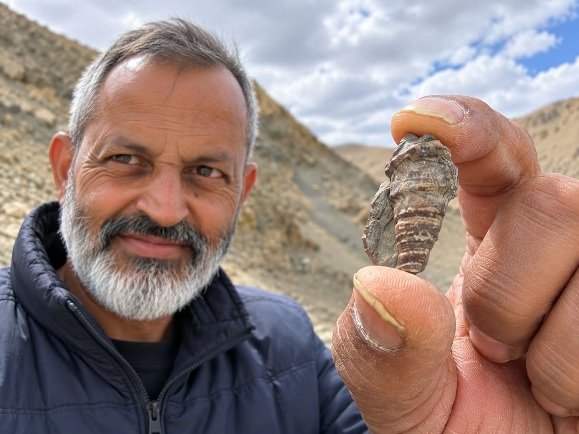
The high-altitude desert of Ladakh may hold evidence of a dramatically different past, when marine life inhabited landscapes that today lie thousands of metres above sea level. This finding unearthed after a remarkable assemblage of Eocene marine fossils has been discovered at Nyoma in the Changthang region by geologist Dr Ritesh Arya, founder of the Tethys Fossil Museum, during an ongoing geological expedition.
Dr Arya informed us that this collection is dominated by Turritella-type gastropods, along with bivalves and oyster-like forms. Preliminary comparison with marine fossil assemblages of the Subathu Formation suggests an age of approximately 34–38 million years. The findings also raise the possibility that the Eocene marine realm associated with the Subathu Formation extended farther eastwards into Ladakh than previously recognised.
“When I first saw the gastropods at Nyoma, I immediately recognised something familiar. They looked remarkably similar to the fossils we regularly collect from the Subathu Formation. But this time I was standing in Nyoma, Ladakh. That was the real surprise,” Dr Arya said.
The discovery builds on earlier work in the Nyoma region. Dr Arya had presented evidence of marine fossils from Nyoma in 2018 at a conference organised by the Wadia Institute of Himalayan Geology in Dehradun. The latest expedition has now yielded a substantially larger collection, allowing the fossils and their geological setting to be examined in greater detail.
Also read 45-Million-Year-Old Snakehead Fish Fossil discovered in Himachal’s Subathu formation
Earlier researchers, including eminent palaeontologist Prof Ashok Sahni and colleagues, had documented freshwater fishes and molluscs from the Kuksho Formation near Nyoma. Subsequent studies recorded plant and vertebrate fossils from the Liyan Formation and adjoining geological successions.
Dr Arya’s investigations have also noted fossil palms, fossil wood and other plant remains from several Himalayan localities, including Kasauli, Dharamsala, the Stok–Markha Valley, Kargil and Nyoma. During the present expedition, his team has additionally documented a burrow-bearing bed in the Liyan Formation, preserving traces of organisms that lived and moved through ancient sediments.
The combination of marine shells with fossil palms, wood and other plant remains offers a striking picture of an Eocene environment vastly different from present-day Ladakh’s cold, arid landscape. According to Arya, the evidence may point towards warm, near-coastal environments influenced by the ancient Tethyan marine realm.
“The fossils are telling us a very different story of Ladakh. The marine shells, palms, fossil wood and traces of animal activity together suggest a landscape that bears little resemblance to the Ladakh we see today,” he said.
The discovery has also received appreciation from Prof Ashok Sahni, Arya’s PhD supervisor. “Your discovery of marine fossils in Ladakh is on par with your remarkable fossil discoveries in Kasauli. Well done,” Sahni stated.
The specimens are now being documented for detailed taxonomic, stratigraphic and palaeoenvironmental study. Their precise identification and stratigraphic position will be critical in determining their age and relationship with established Eocene marine successions of the Himalaya.
If the proposed correlation is confirmed, the Nyoma assemblage could provide an important new clue to the eastern extent of the Eocene Subathu marine realm and the geological evolution of the Himalaya.
For a region now synonymous with barren mountains and high-altitude deserts, the fossils preserve the memory of a very different world—one where marine gastropods and bivalves lived nearly 40 million years ago, long before Ladakh acquired its present landscape.
About the Author


The HimachalScape Bureau comprises seasoned journalists from Himachal Pradesh with over 25 years of experience in leading media conglomerates such as The Times of India and United News of India. Known for their in-depth regional insights, the team brings credible, research-driven, and balanced reportage on Himachal’s socio-political and developmental landscape.