Giripar village enforces ban on Liquor, extravagance at Weddings to Curb rising social debt

Shimla/Giripar, Jan 14,
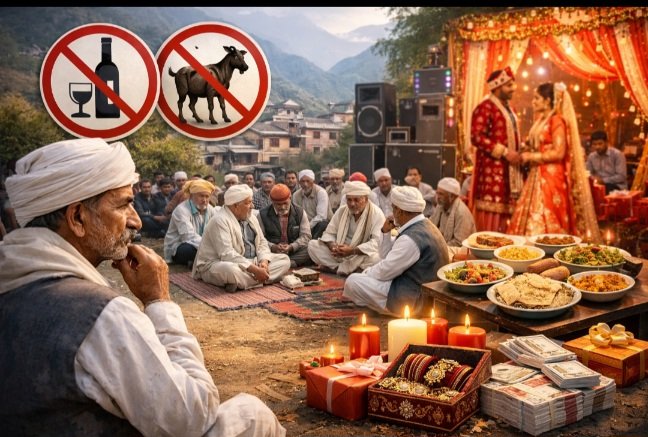
In a rare instance of collective social reform, residents of Tauru village in the Giripar region have unanimously resolved to ban the serving and sale of liquor at marriages and all social functions, alongside imposing strict limits on ceremonial extravagance, in a move aimed at easing the financial burden on families.
The decision was taken during a gram-level meeting held on the occasion of Aanj Bhoj, where villagers expressed growing concern over the escalating costs of traditional ceremonies that have increasingly pushed households—particularly poorer families—into debt.
Under the new community norms, alcohol will neither be served nor sold within the village. The use of DJs at weddings has been restricted to a single day, while the age-old practice of slaughtering goats for labourers (Toluva) has been completely abolished. The scale of feasts linked to childbirth, marriage and death rituals has also been substantially reduced.
Village elders Atar Singh Tomar, Uday Ram Tomar and Ganga Singh Tomar said the initiative was driven by a shared resolve to eliminate social evils associated with ostentation and to protect families from financial distress. They noted that in recent years, the pressure to host lavish weddings had forced many households to take loans or even sell land to meet perceived social expectations.
Traditionally, weddings in Tauru village span nearly five days and include multiple rituals such as the maternal uncle’s welcome, wedding procession, main feast, Nevda, Paltoj, and a separate feast for Toluva under the Hela tradition. With around 450 households in the village, guest numbers often exceeded 1,500, pushing wedding expenses to between Rs 10 lakh and Rs 15 lakh per family.
As per the revised norms, the Paltoj ceremony will now be limited to immediate family members, neighbouring households and a few senior villagers. The Dasuthan ceremony after childbirth will be observed only on the birth of the eldest son, while other births—of sons or daughters—will be marked by inviting just four to five close relatives. The exchange of customary gifts such as ghee, sugar, coins, clothes and utensils has also been discontinued.
Restrictions have also been placed on death-related rituals. Mourning and death anniversary programmes will now remain confined to the immediate family, with participation beyond the 13-day mourning period limited to two or three members of the local fleet.
Villagers estimate that the revised framework could bring down wedding expenses to around Rs 5 lakh. With an average of 10 marriages annually, Tauru village alone expects to save close to Rs 1 crore every year.
A similar experiment had earlier been carried out in Drabill village of Shillai tehsil, where wedding feasts were restricted to a single day.
The Tauru initiative is increasingly being viewed as a model of community-led reform in the Giripar region—one that seeks to preserve cultural traditions while restoring simplicity and shielding families from avoidable economic hardship
About the Author

The HimachalScape Bureau comprises seasoned journalists from Himachal Pradesh with over 25 years of experience in leading media conglomerates such as The Times of India and United News of India. Known for their in-depth regional insights, the team brings credible, research-driven, and balanced reportage on Himachal’s socio-political and developmental landscape.