Shimla, Jan 7,
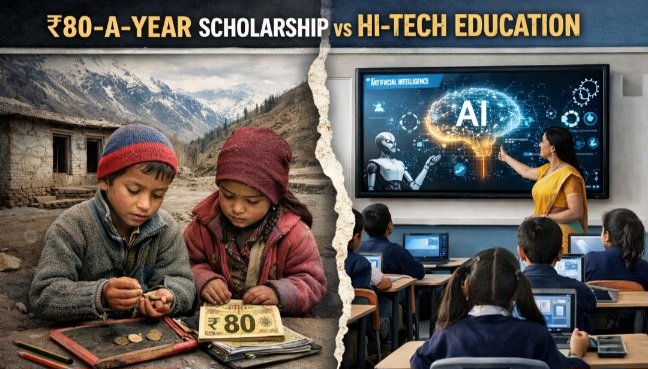
Even as the Himachal Pradesh government showcases smart classrooms, artificial intelligence and digital learning as symbols of educational reform, a little-known scholarship scheme in tribal areas tells a starkly different story—one of neglect frozen in time.
Under an old government provision still in force, students studying in Classes I to VIII in notified tribal regions receive just Rs 80 per year, translating to Rs 6.66 per month. In an era of soaring costs, the amount is so negligible that it fails to cover even basic stationery, raising serious questions about the intent and priorities behind the policy.
The scheme applies to government schools in tribal districts such as Lahaul-Spiti and Kinnaur, and is restricted to students not availing any other scholarship. The Education Department maintains that it is a “traditional assistance scheme” that has continued for decades—an explanation that critics say only highlights administrative apathy rather than justification.
What makes the issue more unsettling is its backdrop: Himachal Pradesh’s Rs 600-crore scholarship scam, which exposed systemic failures in monitoring welfare schemes meant for SC, ST and minority students. Investigations into the scam revealed that despite massive budgetary allocations, genuine beneficiaries were frequently underpaid, excluded or entirely denied benefits, while funds were misused or diverted.
Education activists argue that this contrast—between a multi-crore scam and a stagnant ₹80 scholarship—reflects skewed governance. Gyan Vigyan Samiti functionary Jiya Nand Sharma said the state’s approach exposes misplaced priorities. “On one hand, money meant for students is siphoned off; on the other, tribal children are handed a pittance in the name of welfare,” he said.
Director of School Education Ashish Kohli acknowledged that the scheme has outlived its relevance and confirmed that a proposal for rationalisation has been sent to the government. He said the scholarship structure is currently under review.
Adding to the criticism, former IAS officer Arun Sharma has repeatedly flagged corruption risks in education programmes, particularly those involving infrastructure spending and student-centric benefits. Independent surveys by state-level organisations have also pointed to frequent leakages and delivery failures in welfare schemes.
The renewed debate has sharpened demands for a comprehensive overhaul of Himachal’s scholarship framework—one that goes beyond digital dashboards and AI branding to address core issues of adequacy, transparency and equity. For many, the question is no longer about modernising education rhetoric, but whether the state is genuinely committed to justice for its most vulnerable students.
About the Author

The HimachalScape Bureau comprises seasoned journalists from Himachal Pradesh with over 25 years of experience in leading media conglomerates such as The Times of India and United News of India. Known for their in-depth regional insights, the team brings credible, research-driven, and balanced reportage on Himachal’s socio-political and developmental landscape.