Fire NOC relaxation for hotels and homestays in Himachal—What changes now


Shimla, Feb 3,
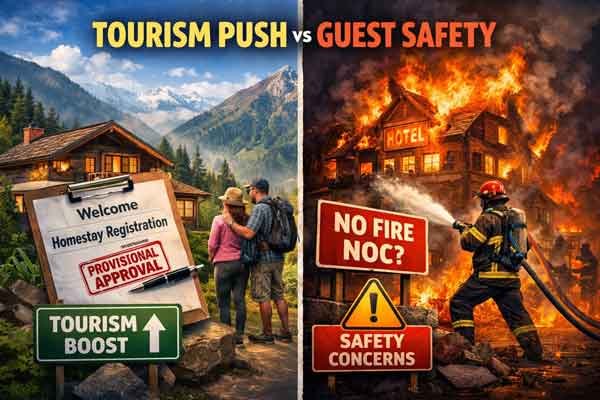
The Himachal Pradesh government’s recent decision to allow provisional registration and renewal of hotels and homestays without an immediate Fire No Objection Certificate (NOC) has reopened an old but critical debate—how far can ease of doing business go without compromising public safety? Announced alongside the launch of a simplified homestay registration portal, the move has been positioned as a tourism-friendly reform aimed at reducing procedural hurdles for small operators.
Chief Minister Thakur Sukhvinder Singh Sukhu has clarified that hospitality businesses should not be harassed on technical objections and that Fire NOC-related delays should not stall renewals. The tourism department has been directed to issue provisional registrations so that operations continue uninterrupted. For many homestay owners and small hoteliers—particularly in rural and semi-urban areas—this is being welcomed as long-overdue relief.
Why the decision appeals to the tourism industry
Tourism remains one of Himachal Pradesh’s strongest economic pillars, supporting thousands of families directly and indirectly. Homestays, in particular, have emerged as a livelihood option for middle-income households, allowing residents to monetise spare rooms while offering visitors a local experience.
Operators have long complained that Fire NOC approvals often take months due to staffing shortages, inspections backlogs, and overlapping departmental jurisdictions. During this period, renewals get stuck, bookings are lost, and incomes suffer. From this perspective, provisional registration appears to be a pragmatic administrative solution—especially when the government is actively promoting “tourism for self-employment.”
The uncomfortable question of safety
However, fire safety is not a routine formality. A Fire NOC certifies that a building meets essential safety standards—adequate exits, firefighting equipment, alarms, and evacuation plans. In a hill state like Himachal Pradesh, where hotels frequently operate on steep terrain, narrow access roads, and in older structures (sometimes with wooden components), fire risks are inherently higher.
Across India, past incidents underline the consequences of diluted enforcement. Fatal hotel fires in metropolitan cities have been traced to blocked exits and absent fire safety systems. In hill states such as Uttarakhand, authorities have previously sealed hotels operating without fire clearances, explicitly citing guest safety concerns. These examples raise a valid concern: can provisional operation without Fire NOC expose tourists and staff to avoidable risks?
The legal and policy balance
From a legal standpoint, provisional registration is not inherently unlawful. Governments do have administrative discretion to provide temporary relief, provided such measures are time-bound, conditional, and monitored. The policy becomes problematic only if “provisional” turns into a permanent workaround, with repeated extensions and weak enforcement.
If hotels continue operating indefinitely without Fire NOC compliance, the state could face serious liability questions—particularly if an accident occurs. Indian courts have repeatedly held that economic convenience cannot override the right to life and public safety.
Where the policy can succeed—or fail
The success of this decision depends entirely on implementation. If provisional registrations are capped to a strict timeframe—say three to six months—with mandatory inspections and clear deadlines for obtaining Fire NOC, the policy can strike a workable balance between tourism promotion and safety.
But if enforcement remains lax and follow-ups weak, the move risks being perceived as the state becoming “soft” on a core safety requirement in the name of growth.
Himachal Pradesh’s identity as a safe and responsible tourist destination is as valuable as its scenic appeal. Supporting hospitality entrepreneurs is essential, but not at the cost of guest safety. The government’s latest decision offers short-term relief, but its long-term credibility will rest on one test alone: whether fire safety remains non-negotiable in practice, not just on paper.
About the Author


The HimachalScape Bureau comprises seasoned journalists from Himachal Pradesh with over 25 years of experience in leading media conglomerates such as The Times of India and United News of India. Known for their in-depth regional insights, the team brings credible, research-driven, and balanced reportage on Himachal’s socio-political and developmental landscape.