


Shimla, August 8
Shimla’s proposed no-construction regime has brought into focus a glaring contradiction in the State Government’s approach to disaster management: while restrictions are being proposed for private construction in the name of protecting the fragile ecology of the hill capital, government agencies themselves continue with excavation, digging, mining and construction activities at several vulnerable locations.
The Town and Country Planning Department is preparing to notify several congested parts of Shimla’s core area as no-construction zones, covering areas above the road passing through Sanjauli, College of Excellence, IGMC, Lakkar Bazaar, the Ridge, Mall Road, Clarkes Hotel, Oakover, Chhota Shimla and adjoining localities. New private construction is proposed to be prohibited, while government buildings for public purposes and reconstruction of existing structures on their original lines will remain permissible.
The proposal may be justified on ecological and disaster-management grounds. However, the government’s credibility is likely to be tested by what is happening on the ground.
At a time when the administration is warning citizens against construction in environmentally sensitive and disaster-prone areas, government departments and agencies themselves are undertaking excavation, hill cutting, digging and other construction activities at various locations in and around Shimla. Such activities can disturb natural drainage, weaken slopes and increase the possibility of subsidence and landslides, particularly during the monsoon.
The continuing construction of a duct between Chhota Shimla and Mall Road during the rainy season has already attracted attention. Excavation and heavy construction activity in a fragile hill environment during periods of rainfall can disturb the stability of slopes and natural drainage channels. The uprooting of trees in the vicinity has further intensified concerns among residents about the manner in which such projects are being executed.
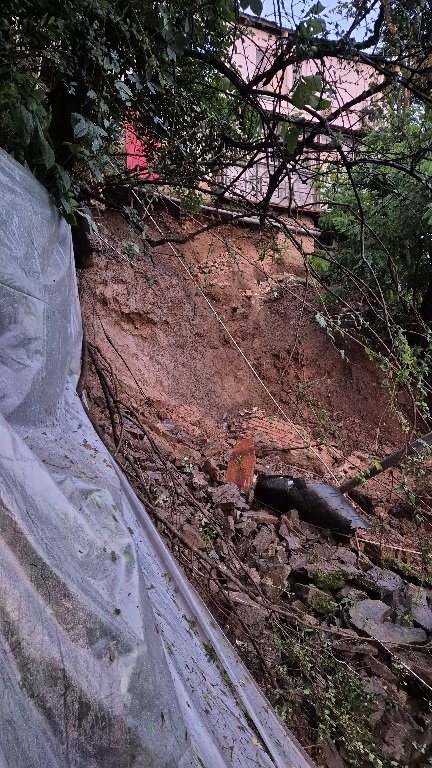
The situation becomes particularly worrying when viewed against repeated incidents of subsidence and slope failure along the Cart Road and below Sabzi Mandi. The area has witnessed damage to old structures and instability on several occasions, yet excavation and construction pressures have not disappeared.
The question is therefore not simply whether private construction should be banned. The more fundamental question is whether the government is applying the same environmental and geological standards to its own projects.
If a slope is considered too fragile for a private citizen to construct a house, why should a government department be permitted to undertake extensive excavation or hill cutting on the same or a similarly vulnerable slope without making a detailed geological and hydrological assessment public?
Shimla’s vulnerability cannot be measured merely by the amount of rainfall received during a particular monsoon. Even when rainfall remains below exceptionally high levels, incidents of subsidence, slope movement, falling trees and damage to roads and buildings continue to be reported. This suggests that the city’s disaster vulnerability is increasingly linked to human intervention, alteration of natural drainage, indiscriminate excavation and pressure on already stressed slopes.
There is growing criticism that government policy is becoming increasingly restrictive for ordinary residents while government agencies continue to undertake large-scale infrastructure works with limited public scrutiny. In several suburban and rural areas, the government is also declaring additional land as green areas, affecting the development rights of local residents without, in many cases, adequately taking them into confidence.
Such a policy risks creating a perception that environmental regulations are meant primarily for citizens while the State retains considerable discretion for its own construction activities.
The bureaucracy also appears to be trapped in a cycle of workshops, meetings, committees and preparedness exercises. Officers frequently discuss disaster preparedness and sustainable development in air-conditioned conference rooms, while on the ground excavators continue to cut into fragile slopes and construction material is moved through vulnerable areas during the monsoon.
Shimla does not need more workshops alone. It needs strict enforcement of scientific recommendations at construction sites.
Before undertaking any major government project involving hill cutting, excavation, tunnelling, mining or alteration of natural drainage, an independent geological and slope-stability assessment should be mandatory. The findings should be placed in the public domain, particularly when the project is located in a known subsidence- or landslide-prone area.
The State Government also needs to establish accountability for government construction. If a government project contributes to slope failure, subsidence, damage to property or loss of vegetation, responsibility should not disappear into files moving from one department to another.
The proposed no-construction policy could be an important intervention to protect Shimla, but it risks becoming another example of bureaucratic regulation detached from ground realities if government agencies are allowed to continue activities that themselves increase disaster vulnerability.
Shimla’s fragile slopes do not distinguish between a government excavation and a private construction project. Gravity, geology and water follow their own rules. A landslide does not recognise departmental boundaries.
The government therefore needs to decide whether its priority is genuinely disaster prevention or merely regulating what ordinary citizens are allowed to build.
Restricting private construction while permitting potentially hazardous government excavation and construction could create a dangerous double standard. In a city already showing signs of subsidence and slope instability, such selective enforcement may not prevent the next disaster—it could be contributing to the conditions that invite it.
About the Author


