Himachal apple belt fires: Satellite data points to man-made incidents during winter



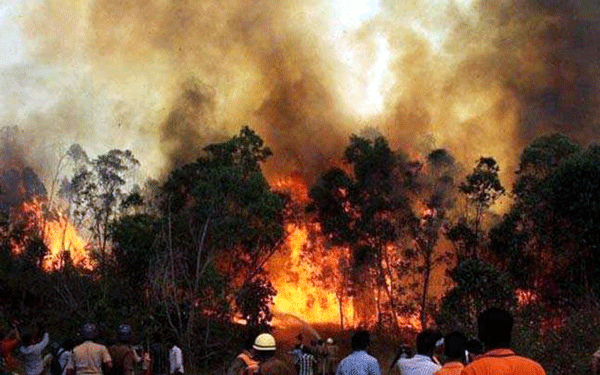
Forest fire old photo used for indicative purpose only
Himachal apple belt fires: Satellite data points to man-made incidents during winter
Shimla, March 14,
Satellite-based analysis of fire incidents in Himachal Pradesh has brought forward a important insight about Himachal apple belt fires. It indicated that a majority of fires recorded in the apple-growing regions are likely linked to human activities, particularly the burning of horticultural waste after winter pruning.
The study, based on fire detection data from NASA and NOAA satellites, shows that nearly three-fourths of the fire incidents recorded in the state occur in non-forest areas, suggesting that many of them originate from agricultural or orchard waste burning rather than natural forest fires.
The analysis uses data from the Visible Infrared Imaging Radiometer Suite (VIIRS) sensor aboard the Suomi-NPP and NOAA-20 satellites, which can detect active fire hotspots across the globe with a spatial resolution of about 375 metres.
According to the findings, around 2,343 fire incidents were detected through VIIRS satellite data, significantly higher than the 240 fires recorded through MODIS satellite observations for the same period.
A seasonal pattern also emerges from the analysis. Nearly 70–75 percent of the fire incidents occur during the winter months from November to March, coinciding with the period when apple orchards are pruned and farmers dispose of dry twigs and leaves.
Also read:Forest fires due to systemic shortcomings or warm climate?
District-wise distribution of the fire incidents indicates that the upper Shimla region accounts for about 32 percent of the cases, followed by the Kullu region with nearly 24 percent. These areas form the core of the state’s apple belt.
The analysis on fire incidences in Himachal Pradesh’s apple-growing regions was carried out by Shashi Shekhar, Scientific Officer at the Himachal Pradesh State Pollution Control Board (HPSPCB) and published in August 2024.
The study examined fire events recorded during 2023 and the winter season of November 2023 to March 2024, using satellite-based fire detection data from NASA and NOAA platforms, particularly the VIIRS (Visible Infrared Imaging Radiometer Suite) sensors aboard the Suomi-NPP and NOAA-20 satellites, along with MODIS data from the Terra and Aqua satellites. By analysing these datasets and overlaying them with land-use and forest density maps, the study assessed the spatial and seasonal distribution of fires across Himachal Pradesh, especially in apple-producing districts such as Shimla, Kullu, Mandi, and Chamba, concluding that a large share of winter fires are linked to the burning of horticultural waste in orchards.
Experts say the practice of burning pruning waste has been prevalent in the region for decades. The practice reportedly began in the 1980s when growers were advised to burn orchard waste to prevent the spread of scab disease in apple trees. Over time, however, the number of orchards in the state has increased significantly, raising environmental concerns over the continued burning of biomass.
Despite the higher number of fires detected through satellite imagery, pollution monitoring indicates that the impact on air quality remains relatively limited for now. Satellite-based atmospheric observations suggest that pollution levels in the region are still within permissible limits, though experts say the trend requires attention.
The findings underline the growing challenge faced by environmental regulators in distinguishing between forest fires and biomass burning in orchard regions. While roughly 25–30 percent of the fires can be linked to forest areas, the majority appear to be associated with human activities in agricultural and horticultural lands.
Authorities have repeatedly urged farmers to avoid burning pruning waste and instead utilise it for composting or other forms of biomass use. However, the practice continues in many orchard areas due to the lack of affordable alternatives for disposing of the large volume of pruning residues generated every winter.
Environmental experts say that while the pollution impact currently appears localised, continued burning of horticultural waste could pose long-term challenges for air quality and ecosystem health in the fragile Himalayan region.
About the Author


The HimachalScape Bureau comprises seasoned journalists from Himachal Pradesh with over 25 years of experience in leading media conglomerates such as The Times of India and United News of India. Known for their in-depth regional insights, the team brings credible, research-driven, and balanced reportage on Himachal’s socio-political and developmental landscape.