Himachal Budget 2026-27: Rs 54,928 Cr Plan, Salary Cuts Announced to Manage Finances


Himachal Budget 2026-27: Rs 54,928 Cr plan, Salary cuts announced to manage finances
Shimla, March 21,
In a clear admission of mounting financial stress, the Himachal Pradesh government on Friday presented a Rs 54,928 crore budget for 2026–27, combining austerity measures with targeted welfare and revenue push strategies. The most striking announcement — temporary salary deferment across political executive, bureaucracy, and sections of employees — underlines the state’s continuing struggle to stabilise its finances even as it projects gradual improvement over last year.
Last year (2025–26), the Himachal Pradesh budget was Rs 58,514 crore. So, compared to this year’s Rs 54,928 crore, the current budget is lower by roughly Rs 3,586 crore, indicating a contraction in overall outlay — which aligns with the austerity and cash-management measures announced this time.
This year budget pegs the revenue deficit at Rs 6,577 crore, a notable improvement from Rs 9,812 crore in 2025–26, suggesting tighter fiscal management. However, the fiscal deficit stands at Rs 9,698 crore (3.40% of GSDP), indicating that structural financial pressure remains far from resolved. Total receipts are estimated at Rs 53,555 crore, including Rs 40,261 crore from revenue receipts and Rs 13,193 crore from capital accounts, of which Rs 11,965 crore will come through public debt.
The revenue composition continues to show heavy dependence on external flows and taxation. Out of every Rs 100, about Rs 28.05 is expected from central taxes, Rs 28.55 from state taxes, Rs 13.40 from grants-in-aid and Rs 22.34 from public debt, reflecting a continued reliance on borrowings and central transfers — a concern that has repeatedly surfaced in economic assessments of the state.
On the expenditure side, priorities remain tilted towards committed liabilities and social obligations. Around 41.14 per cent will go to general services and 31.46 per cent to social services, while economic services will account for 11.29 per cent.
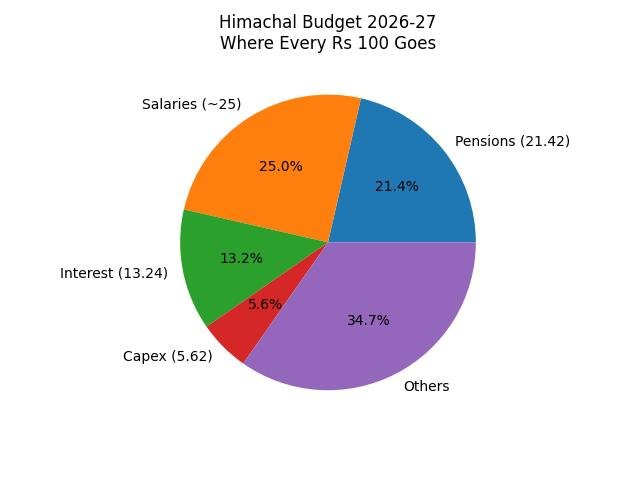
A deeper look shows that pensions alone will consume 21.42 per cent of every Rs 100 spent, salaries around 25 percent, while interest payments will take 13.24 per cent, leaving limited room for development spending. Capital expenditure remains low at just 5.62 per cent, underlining the structural constraint on asset creation.
In a major austerity measure, the government has announced temporary salary deferment for six months. The Chief Minister will see a 50 per cent deferment, ministers, Speaker and Deputy CM 35 per cent, MLAs 20 per cent, senior IAS and top officers up to 30 per cent, and Group A and B employees 3 per cent. Pensioners and Group C and D employees have been kept out of this decision, signalling an attempt to protect lower-income segments. The move comes in the backdrop of recurring delays in salary and pension disbursements over the past year and points to ongoing liquidity management challenges.
Despite the financial strain, the government has attempted to balance austerity with welfare commitments. Pension arrears of pre-2016 pensioners will be cleared in 2026–27, while about Rs 300 crore has been earmarked to clear gratuity and leave encashment dues of retired Class IV employees. Honorariums for Anganwadi, ASHA, mid-day meal workers, Jal Rakshaks and several other categories have been increased. Daily wages have been raised to Rs 450, while outsourced workers will receive Rs 13,750 per month.
The revenue strategy centres on strengthening the power sector and improving compliance. The government expects around Rs 2,500 crore from power projects and royalties, alongside expansion of solar and hydropower initiatives, including installation of solar panels on government buildings and promotion of village-level solar projects. Digitisation of 17 lakh government records, a single online service portal and stricter GST enforcement are also part of the plan to enhance revenue efficiency.
Compared to the previous year, the reduction in revenue deficit does offer a positive signal, but the broader picture remains mixed. Continued dependence on borrowings, limited capital expenditure and the need to defer salaries indicate that financial stress persists beneath the surface. The budget attempts to project fiscal correction while simultaneously acknowledging constraints — a balance that is likely to face political scrutiny.
Also read:Himachal Economic Survey 2025-26 debt burden in focus as RDG exit looms
Other announcements include a 50 per cent cut in MLA priority funds to Rs 1.10 crore, while the MLA area development fund has been increased to Rs 225 crore. A new Paramilitary Welfare Board will be set up, and the 3 per cent reservation for ex-servicemen will continue.
The 2026–27 budget ultimately reflects a government managing within tight fiscal limits — showing signs of correction, but still grappling with deep-rooted financial challenges.
About the Author


The HimachalScape Bureau comprises seasoned journalists from Himachal Pradesh with over 25 years of experience in leading media conglomerates such as The Times of India and United News of India. Known for their in-depth regional insights, the team brings credible, research-driven, and balanced reportage on Himachal’s socio-political and developmental landscape.