HP High Court seeks larger bench opinion on police and forest officials’ Powers under Forest Act

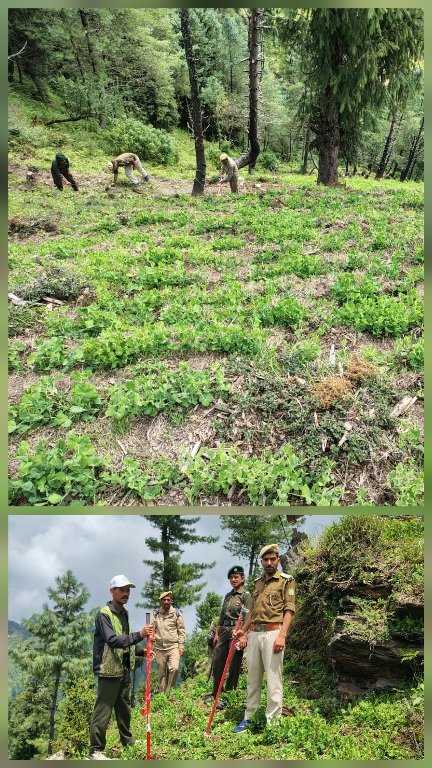
Photo used for indicative purpose only. Source internet
Ruling may impact hundreds of forest offence cases pending across Himachal Pradesh
Shimla, Nov 11,
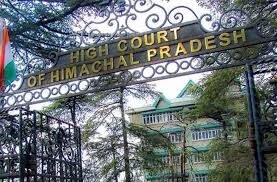
The Himachal Pradesh High Court has raised a legal question over the interpretation of the Indian Forest Act, 1927 (IFA), referring it to a Larger Bench to clarify the extent of powers vested in police and forest officials to arrest and prosecute offenders under forest laws.
The development comes in the case of State of H.P. vs. Prem Chand & another, where Justice Rakesh Kainthla highlighted inconsistencies in previous judicial interpretations concerning whether offences under the Act are cognizable or not. The ruling could influence the course of hundreds of forest offence cases currently pending in various courts across the state, many involving illegal felling and transportation of timber and other forest produce.
The trial court in the matter had relied upon an earlier 2009 judgment (State of H.P. vs. Satpal Singh @ Satta, 2009 HHC 2213), which held that offences under Sections 41 and 42 of the IFA were non-cognizable and non-bailable. However, Justice Kainthla noted that the Satpal Singh ruling had not examined Section 64 of the Forest Act — a provision that specifically empowers police officers to arrest, without warrant, any person reasonably suspected of involvement in a forest offence.
“Since Section 64 confers the power of arrest without warrant, the offences under the Forest Act cannot be treated as non-cognizable,” the court observed in its judgment.
The order also drew attention to Rule 21 of the Himachal Pradesh Forest Produce Transit (Land Routes) Rules, which prescribes a maximum imprisonment of two years or a fine up to Rs 5,000 for violations, with penalties doubling if the offence is committed between sunset and sunrise. “In the present case, the alleged offence occurred at night; hence, the imprisonment could extend up to four years,” the court recorded, indicating that such offences may not fall within the ambit of minor, non-cognizable acts.
Justice Kainthla emphasized that the issue directly concerns the operational authority of both the Forest Department and the police in enforcing forest protection laws. “Given the apparent inconsistency and the potential impact on law enforcement, the matter warrants examination by a Larger Bench,” he stated, while referring the issue to the Chief Justice for appropriate consideration.
The Larger Bench will now examine the specific legal question — “Whether the offence punishable under Section 42 of the Indian Forest Act read with Rules 11 and 20 of the HP Forest Produce Transit (Land Routes) Rules is non-cognizable.”
The outcome is expected to bring much-needed clarity to the overlapping jurisdiction of forest and police authorities, and could set a new precedent shaping future investigations and prosecutions in Himachal’s forest-related offences.
About the Author

The HimachalScape Bureau comprises seasoned journalists from Himachal Pradesh with over 25 years of experience in leading media conglomerates such as The Times of India and United News of India. Known for their in-depth regional insights, the team brings credible, research-driven, and balanced reportage on Himachal’s socio-political and developmental landscape.