Rs 3,920 Crore ‘Pride of Hills’ push: Partial fix for Himachal’s monetary gap?

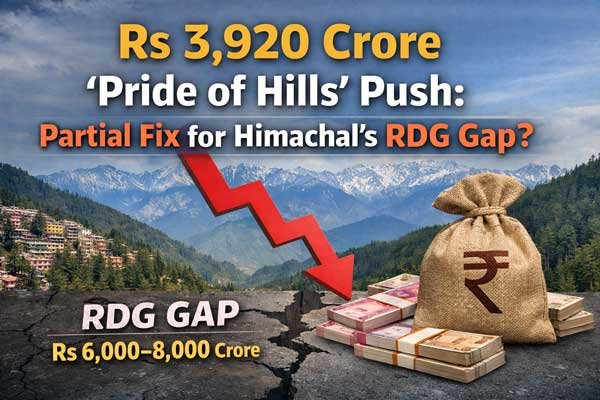
AI generated image. Used for indicative purpose only
Rs 3,920 Crore ‘Pride of Hills’ push: Partial fix for Himachal’s monetary gap?
Shimla, March 31,
Rs 3,920 Crore ‘Pride of Hills’ push: Partial fix for Himachal’s monetary gap?
At a time when Himachal Pradesh is navigating a tightening fiscal space, the Centre’s newly announced “Pride of Hills” package—allocating Rs 3,920 crore to the state—signals not just financial relief, but a shift in how hill economies may now be expected to sustain themselves.
Unlike earlier support mechanisms that directly bridged revenue gaps, this assistance—routed through the Special Assistance to States for Capital Investment (SASCI) 2026–27—comes with a clear emphasis: spend on assets, not adjustments.
The broader Rs 25,000 crore outlay for hill states acknowledges structural disadvantages such as difficult terrain, scattered populations and limited avenues for revenue generation. Yet, the design of the scheme marks a departure from past frameworks. Instead of compensating for deficits, the focus is now on capital expenditure—roads, infrastructure and long-term asset creation. For Himachal, this effectively means that fiscal stress will need to be addressed not through direct grants, but through growth-led correction.
This transition is significant. It subtly shifts the responsibility of balancing finances from central cushioning to state-led economic expansion.
With Rs 3,920 crore, Himachal is among the top beneficiaries, second only to Arunachal Pradesh, which has been allocated Rs 4,900 crore. Comparable allocations to states like Nagaland at Rs 3,880 crore and Uttarakhand at Rs 3,460 crore indicate a relatively even distribution among hill economies facing similar constraints.
The context becomes sharper when viewed against the estimated fiscal gap emerging after the discontinuation of the Revenue Deficit Grant. State-level assessments have indicated that Himachal Pradesh could face an annual revenue shortfall in the range of Rs 6,000 crore to Rs 8,000 crore, depending on expenditure trends and revenue realisation. In that context, the Rs 3,920 crore assistance, while significant, only partially offsets the structural gap that had earlier been cushioned through RDG support.
Also read: Zero RDG, low tax share: Why Himachal’s budget math is getting harder
However, this also raises a critical question of whether parity in allocation reflects parity in fiscal stress, especially in a state like Himachal where committed expenditure on salaries, pensions and subsidies remains substantial.
Officials have framed the package as a mechanism to strengthen infrastructure and stimulate long-term growth, with the expectation that improved connectivity and asset creation will eventually expand the tax base. However, such gains typically unfold over time. In the immediate term, the state continues to face pressure in managing routine financial obligations alongside the need for investment.
Leader of Opposition Jai Ram Thakur welcomed the allocation and expressed gratitude to Prime Minister Narendra Modi, stating that the assistance would support infrastructure development and urging effective utilisation of the funds. The political response reflects broad acknowledgment of the package’s importance, but it also places the spotlight on implementation.
Here it noteworthy that past audit observations have repeatedly highlighted concerns around delays and underutilisation in capital expenditure. If these patterns persist, the intended impact of the scheme could be diluted despite the scale of allocation.
The “Pride of Hills” initiative may therefore represent more than a compensatory measure. It indicates a structural shift in how fiscal support to hill states is being approached.
For Himachal Pradesh, the real test will lie in its ability to translate this capital push into tangible economic outcomes while maintaining balance in its day-to-day financial commitments.
The package offers a window of opportunity, but not a complete cushion. As debates continue over whether it sufficiently offsets emerging fiscal pressures, the state’s trajectory may ultimately depend on how effectively it converts this investment into sustained growth.
About the Author

The HimachalScape Bureau comprises seasoned journalists from Himachal Pradesh with over 25 years of experience in leading media conglomerates such as The Times of India and United News of India. Known for their in-depth regional insights, the team brings credible, research-driven, and balanced reportage on Himachal’s socio-political and developmental landscape.