Was Himachal’s fiscal crisis avoidable? Dhumal questions Govt preparedness


Shimla, Jan 9,
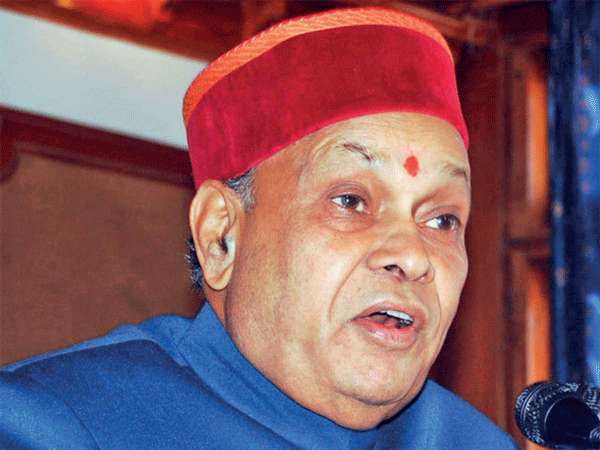
As Himachal Pradesh debates over mounting fiscal stress and repeated assertions about an “empty treasury,” former Chief Minister Prof. Prem Kumar Dhumal on Monday raised a fundamental question: Was the current financial strain avoidable?
Referring to the phased withdrawal of the Revenue Deficit Grant (RDG), Dhumal asserted that the development was neither sudden nor unexpected. The 15th Finance Commission had clearly recommended that RDG to Himachal Pradesh would taper off and conclude by March 31, 2026. Therefore, he said, presenting the phase-out as a fresh financial shock is not right.
According to Dhumal, the real issue is not the end of RDG, but the absence of timely financial planning. “If the withdrawal was known in advance, why was a long-term revenue transition strategy not prepared?” he questioned, suggesting that the government had sufficient time to evaluatr a alternative resource mobilisation mechanism.
RDG exit timeline was pre-determined
The former Chief Minister emphasized that Finance Commission recommendations are constitutionally binding in nature and implemented by the Centre as part of fiscal federal arrangements. The RDG framework for special category and revenue-deficit states like Himachal was structured with a clear tapering schedule, he added.
He argued that responsible governance requires anticipating such structural transitions. “Economic challenges are not new for hill states with limited resources. What matters is preparedness and fiscal discipline,” he said.
Dhumal stressed that fiscal stress cannot be resolved through political rhetoric or public speeches. Instead, he called for strict expenditure control and disciplined financial management.
Drawing from his tenure, he said difficult financial periods were handled through austerity measures — including curbing discretionary expenditure, restricting non-essential travel, and minimizing administrative luxuries. According to him, financial prudence must begin from the top leadership to send a message of seriousness.
Without naming individuals directly, he took a swipe at what he described as increasing administrative expenditure, including appointments of chairpersons, advisors, and additional office-bearers. “If the situation is genuinely severe, the first corrective step should be cutting non-essential expenditure,” he remarked.
Revenue generation vs Revenue dependence
Highlighting structural reforms during his tenure, Dhumal said efforts were made to strengthen agriculture and horticulture as revenue multipliers. He claimed vegetable production turnover rose from around Rs 250 crore annually to nearly Rs 2,250 crore during that period. Crop diversification, he added, helped offset fluctuations in apple production and stabilized income streams.
His broader argument was that long-term fiscal stability depends more on expanding the state’s economic base than on external grants.
Centre–State narrative
On the political narrative surrounding Centre–State relations, Dhumal maintained that Finance Commission recommendations are institutional decisions, not discretionary political actions. He said instead of attributing fiscal pressure solely to the Centre, the state government should present a transparent fiscal roadmap to the public. Also read:
Himachal faces Rs 6,000 Crore resource gap after RDG exit, Govt presentation shows
Confidence vs Crisis Messaging
Concluding his remarks, Dhumal cautioned that repeated public statements about financial bankruptcy could weaken investor confidence and public morale. What is required, he said, is a comprehensive review of expenditure, clear prioritisation of essential spending, and strategic revenue planning.
After the former Chief Minister’s statement in public domain the debate over RDG preparedness now brings a larger question into focus — whether Himachal Pradesh’s current fiscal strain is a structural inevitability or a consequence of delayed financial planning.
About the Author


The HimachalScape Bureau comprises seasoned journalists from Himachal Pradesh with over 25 years of experience in leading media conglomerates such as The Times of India and United News of India. Known for their in-depth regional insights, the team brings credible, research-driven, and balanced reportage on Himachal’s socio-political and developmental landscape.