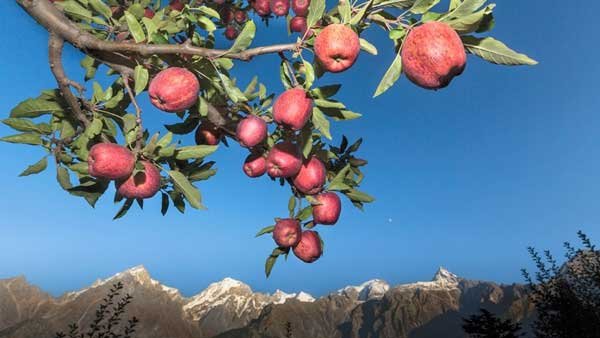
Apple in Kinnaur photo used for indicative purpose only. Source: Internet
Shimla, Dec 24,
The Rs 5,500-crore apple economy supporting over three lakh hill families may face fresh uncertainty after India cut import duty on New Zealand apples under the newly signed Free Trade Agreement (FTA), triggering fears of price crashes and income erosion across Himachal Pradesh, Uttarakhand and Jammu & Kashmir.
The recently concluded Free Trade Agreement (FTA) between India and New Zealand has triggered deep anxiety across apple-growing regions, with orchardists warning that the cut in import duty could destabilise prices, erode farm incomes and push thousands of hill families into distress at a time when the domestic fruit economy is already under pressure.
Also read:Apple Growers feel betrayed as Import duty remains unchanged
Under the FTA, import duty on New Zealand apples has been reduced from 50 per cent to 25 per cent under a tariff-rate quota for the April 1 to August 31 period — a window growers say directly overlaps with India’s apple marketing season, contrary to official claims that domestic fruit is absent during these months. In Himachal Pradesh alone, the apple economy is estimated at around Rs 5,500 crore and supports more than three lakh orchardist families, many of whom depend entirely on seasonal price realisation to service loans and meet household expenses. Growers point out that apples from lower and mid-hill areas begin arriving in mandis from June, with peak arrivals in July and August, while fruit stored in controlled-atmosphere facilities is sold between December and June, meaning cheaper imports from April onwards would exert pressure across almost the entire marketing cycle.
Trade data shows that India already imports over five lakh metric tonnes of apples annually from multiple countries, with New Zealand supplying roughly 30,000–32,000 metric tonnes in recent years — about six per cent of total imports — despite facing a 50 per cent duty so far; orchardists fear that the concessional rate will sharply expand this share once quotas begin to rise in subsequent years.
Grower bodies warn that the move could become a precedent for future trade deals, exposing Indian horticulture to low-cost imports without adequate safeguards.
They argue that production costs in Indian hill states are significantly higher than in New Zealand, where yields per hectare are much greater, giving imported apples a decisive pricing edge in wholesale markets. Apple Growers Association leaders have demanded that import duty be raised to 100 per cent instead of being reduced, warning that even a limited surge of low-duty imports during the harvest window could trigger a market crash, particularly for small and marginal orchardists.
They have also recalled the Prime Minister’s pre-election assurance in Himachal Pradesh that apple import duty would be increased, alleging that the Centre has instead taken a policy U-turn. While the government maintains that safeguards such as quotas and productivity-linked measures are built into the agreement, grower unions insist these are inadequate to protect a labour-intensive hill economy, and are calling for an urgent review of the FTA provisions before concessional imports begin impacting mandis across India’s apple belt.
About the Author

The HimachalScape Bureau comprises seasoned journalists from Himachal Pradesh with over 25 years of experience in leading media conglomerates such as The Times of India and United News of India. Known for their in-depth regional insights, the team brings credible, research-driven, and balanced reportage on Himachal’s socio-political and developmental landscape.