Can Himachal’s forests become its next economic engine?
'People's Forest Economy' vision seeks to link livelihoods with climate action
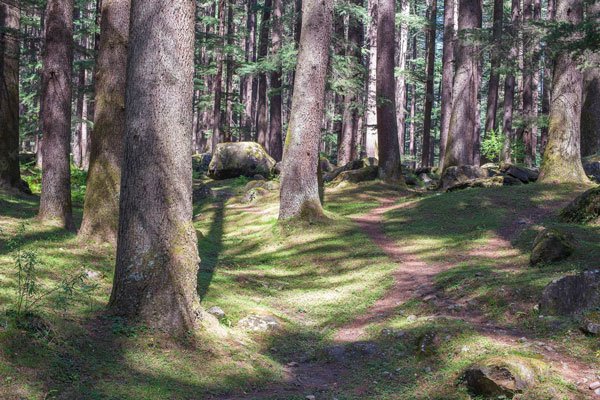
Photo used for indicative purpose only. source: Internet
Can Himachal’s forests become its next economic engine?
Shimla, June 19,
A new forest assessment report prepared jointly by the Himachal Pradesh Forest Department and the Bharti Institute of Public Policy, Indian School of Business (BIPP-ISB), has put forward an ambitious proposition: Himachal Pradesh’s forests should no longer be viewed solely as protected ecological assets, but as the foundation of a future-ready “People’s Forest Economy” capable of generating livelihoods, supporting climate action and strengthening rural prosperity.
The report, Counting Green Wealth: Towards a Future-Ready People’s Forest Economy in Himachal Pradesh, argues that while forests already play a critical role in regulating water resources, preventing soil erosion, supporting biodiversity and storing carbon, their economic contribution remains significantly under-recognised.
According to the report, Himachal Pradesh possesses one of the country’s richest forest endowments, with nearly 68 per cent of its geographical area recorded as forest land. The study estimates that the state’s forests store around 258 million tonnes of carbon, making Himachal a significant contributor to India’s climate mitigation efforts and positioning its forests as strategic climate assets in an era of growing environmental uncertainty.
The findings gain further significance when viewed against the broader economic role forests already play in the state. The forestry and logging sector is estimated to contribute nearly Rs 8,000 crore annually to Himachal Pradesh’s economy, while forest carbon stocks have witnessed substantial growth in recent years. Beyond direct economic activity, forests underpin water security, hydropower generation, horticulture, tourism and disaster resilience, making them integral to several pillars of the state’s economy.
The report comes at a time when India has committed to creating an additional carbon sink of 2.5 to 3 billion tonnes of CO2 equivalent through forest and tree cover as part of its international climate commitments. Against this backdrop, Himachal’s forests are being projected not merely as ecological resources but as long-term economic and climate assets.
However, the report also points to a paradox. While the climate value of forests has increased, the traditional forest economy based on timber and non-timber forest produce has weakened over the years. The study argues that this gap presents an opportunity for the state to redesign its relationship with forests by promoting sustainable forest-based enterprises, biomass utilisation, bamboo-based industries, value-added non-timber forest products and climate-linked livelihood opportunities.
The concept of a “People’s Forest Economy” seeks to place local communities at the centre of this transition. Rather than focusing solely on extraction, the model emphasises sustainable use, ecological restoration, carbon sequestration and community participation in forest governance.
To support this vision, the report highlights the use of modern technologies including artificial intelligence, machine learning, satellite imagery and geo-tagged field inventories. More than 500 forest guards reportedly participated in collecting nearly two lakh tree-level observations across the state, creating what the report describes as a new “forest intelligence layer” for future planning.
The study suggests that such data-driven management can help identify species-wise resource clusters, improve carbon accounting, guide restoration efforts and support climate-resilient forest planning.
For Himachal Pradesh, where forests influence the catchments of major river systems including the Sutlej, Beas, Ravi, Chenab and Yamuna, the implications extend far beyond conservation. Healthy forests help regulate water flows, sustain hydropower projects, protect agricultural landscapes and reduce vulnerability to landslides and soil erosion. These ecosystem services, though rarely reflected in conventional economic indicators, carry immense economic value.
If translated into policy, the report’s recommendations could reshape the way forests are integrated into economic planning and climate strategy. The vision extends beyond conservation towards creating new livelihood opportunities linked to ecosystem restoration, carbon management, sustainable harvesting and value-added forest products.
Whether this vision ultimately translates into jobs, community income and measurable ecological gains will depend on future policy decisions and institutional implementation. Yet the report makes one point abundantly clear: in an era of climate uncertainty, forests may emerge not only as Himachal’s ecological shield but also as one of its most valuable economic assets.
About the Author

The HimachalScape Bureau comprises seasoned journalists from Himachal Pradesh with over 25 years of experience in leading media conglomerates such as The Times of India and United News of India. Known for their in-depth regional insights, the team brings credible, research-driven, and balanced reportage on Himachal’s socio-political and developmental landscape.