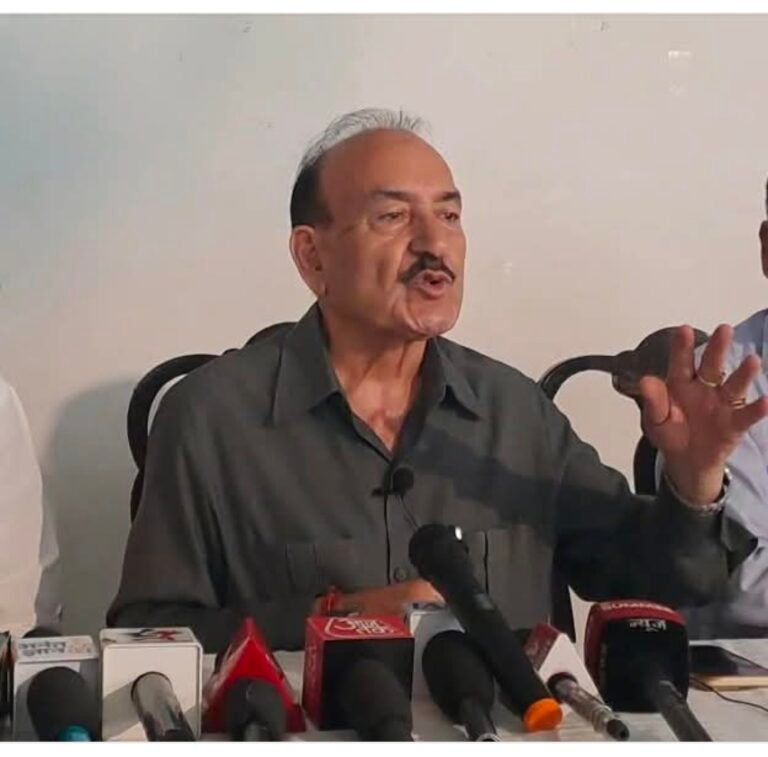


Photo used for indicative purpose only
HP High Court Strikes Down R&P Amendments, Extends Relief to Adhoc and Contract Employees
Shimla, April 26, In a landmark ruling with far-reaching implications, the Himachal Pradesh High Court has struck down key amendments made by the state government to the Recruitment and Promotion (R&P) Rules, holding them unconstitutional and violative of employees’ rights.
The Division Bench comprising Justice Vivek Singh Thakur and Justice Romesh Verma delivered a detailed 278-page judgment on April 25, allowing over 445 civil writ petitions along with connected Letters Patent Appeals. The Court ruled that the state cannot bypass statutory recruitment rules by resorting to adhoc or contractual appointments.
The Bench categorically held that all appointments—whether on regular, contract or adhoc basis—must strictly conform to the notified R&P Rules. It observed that the practice of making appointments without proper advertisement, eligibility scrutiny and procedural compliance undermines the principles of equality in public employment.
Striking down the 2023 amendments, the Court declared several provisions as ultra vires, noting that they were introduced to negate earlier judicial directions and deprive employees of pensionary and promotional benefits. The amendments had imposed arbitrary cut-off dates, particularly post-2003, to deny such benefits. The Court held that retrospective deprivation of accrued rights is legally impermissible.
In a significant relief, the Court directed that employees who were initially appointed on adhoc or contractual basis and later regularised would be entitled to pension and promotional benefits at par with regular employees. It further ordered that benefits already granted pursuant to earlier court rulings shall not be withdrawn or recovered.
Emphasising the role of the state as a model employer, the Bench observed that the government, being the principal employer, cannot discriminate among employees performing identical duties merely on the basis of their mode or timing of appointment. It rejected the state’s argument of financial constraints, stating that economic conditions cannot justify denial of legitimate service benefits to a class of employees.
The Court also laid down a six-point framework directing the state to ensure transparency and uniformity in recruitment. It stressed adherence to the “first come, last go” principle and held that policy decisions affecting service conditions cannot be arbitrarily taken at the level of administrative authorities.
Taking note of past practices, the Bench observed that the state had historically shifted from adhoc appointments to contractual engagements to circumvent judicial rulings that aimed to remove anomalies in service conditions. It pointed out that such policy shifts had resulted in unequal treatment of employees performing similar functions over different periods.
The Court further held that the government cannot amend recruitment rules to override or dilute binding judicial pronouncements. It took exception to the constitution of committees intended to deny the implementation of earlier court orders in cases such as Taj Mohammed vs State of Himachal Pradesh and other connected matters.
The judgment is expected to have wide administrative and financial implications, as thousands of employees across departments—particularly in education and allied sectors—stand to benefit from restored pension and promotional entitlements.
By dismissing a series of state appeals and upholding employees’ claims, the High Court reaffirmed that public employment must be governed by fairness, uniformity and rule of law, rather than shifting policy considerations.
About the Author