Himachal faces Rs 6,000 Crore resource gap after RDG exit, Govt presentation shows
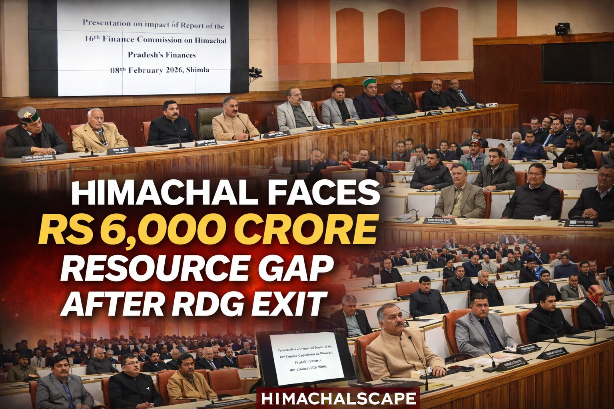
Photo used for indicative purpose only. Source: AI
Shimla, Feb 8,
“Abolition of RDG is not the issue of a government, but a matter concerning the rights of the people of the State,” Chief Minister Sukhvinder Singh Sukhu said while addressing a detailed presentation by the Finance Department on Himachal Pradesh’s financial position.
The presentation, made before Cabinet members, legislators and senior officials, offers an important window into the evolving fiscal outlook of the State following the discontinuation of the Revenue Deficit Grant (RDG).
While the issue has political dimensions, the data shared during the briefing points primarily to a structural financial transition that the State may need to navigate in the coming years.
A structural shift in fiscal support
According to the figures presented, RDG constituted approximately 12.7 percent of Himachal Pradesh’s budget under the 15th Finance Commission — one of the highest proportions among states. The grant functioned as a gap-filling mechanism under Article 275(1) of the Constitution, addressing the difference between assessed revenue and expenditure.
For the period 2021–26, the State’s assessed revenue was placed at Rs 90,760 crore, while assessed expenditure stood at Rs 1,70,930 crore. The resulting deficit was supported through a combination of tax devolution, RDG and other grants.
With the 16th Finance Commission framework not continuing this gap-filling provision in the same manner, the presentation suggests that Himachal will now have to recalibrate its fiscal planning without this support component.
Revenue constraints and committed expenditure
The Finance Department indicated that the State’s own revenue is presently around Rs 18,000 crore, while committed expenditure — including salaries, pensions, interest payments, subsidies and social security commitments — is approximately Rs 48,000 crore.
After factoring in projected central tax devolution and borrowing, total available resources were indicated at roughly Rs 42,000 crore, leaving a projected resource gap of about Rs 6,000 crore for FY 2026–27, excluding developmental works and pending liabilities.
The presentation emphasised that measures to increase revenue or rationalise expenditure may take time to yield results, and therefore the gap cannot be bridged immediately through short-term adjustments alone.
GST and tax growth concerns
The State government communication also refers to the impact of the post-GST tax regime. It was stated that tax growth prior to GST averaged 13–14 percent, compared to around 8 percent thereafter. As a producer state with a relatively small consumer base, Himachal’s revenue dynamics differ from larger consumption-driven economies.
This aspect reflects a broader fiscal federalism debate rather than a state-specific administrative issue.
Focus on resource mobilisation
The government indicated that it remains committed to welfare schemes and to increasing the State’s resource base without imposing additional burden on the common citizen. Efforts toward revenue mobilisation, recovery of pending dues related to hydro power projects, and strengthening negotiations over power royalties appear to be part of the broader strategy.
The emphasis during the presentation was not on immediate crisis, but on the long-term implications of altered fiscal support structures.
Likely Implications
Based on the data shared, certain reasonable conclusions can be drawn that budget prioritisation may become sharper, development expenditure may require careful sequencing, borrowing could continue within permissible fiscal limits, Revenue augmentation efforts may intensify and engagement with the Centre on fiscal matters may increase.
At the same time, the government has reiterated its intent to continue welfare commitments and safeguard public interest.
A transition phase
Himachal Pradesh, like other hill states, has historically faced structural cost disadvantages due to terrain, dispersed population and limited revenue bases. Previous Finance Commissions addressed this through mechanisms such as RDG.
The current shift appears to signal a transition in how such fiscal gaps are treated at the national level.
Now how effectively the State adapts will depend on fiscal management, revenue innovation and inter-governmental engagement in the years ahead.
For now, the presentation by the State government serves as an early indicator that Himachal Pradesh is preparing for a tighter fiscal environment while seeking long-term structural solutions.
About the Author

The HimachalScape Bureau comprises seasoned journalists from Himachal Pradesh with over 25 years of experience in leading media conglomerates such as The Times of India and United News of India. Known for their in-depth regional insights, the team brings credible, research-driven, and balanced reportage on Himachal’s socio-political and developmental landscape.