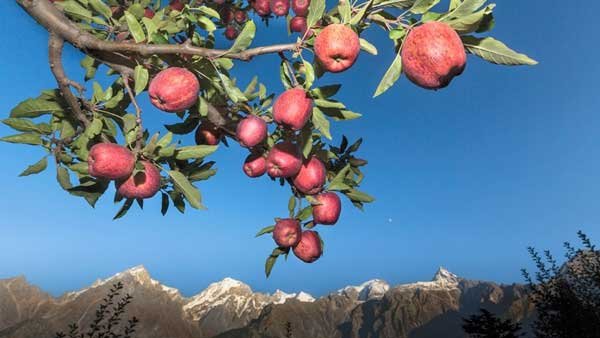
Apple in Kinnaur photo used for indicative purpose only. Source: Internet
Shimla, Feb 10,
Will Rs 100 per kg Washington apple become a flashpoint for Himachal farmers is a question looming apple growers of Himachal Pradesh since India- U.S deal has been made public. If Washington apples begin landing in India at around Rs 100 per kilogram under the proposed India–US trade understanding, what happens to Himachal, Uttrakhand and Kashmir’s orchard economy?
That question is now echoing across apple-growing belts after apple growers raised concerns over the reported reduction in import duty on US apples from 50% to 25%, coupled with a Minimum Import Price (MIP) of Rs 80 per kg.
Farmers argue that even with safeguards, the new framework could alter market dynamics at a sensitive time for domestic producers.
The core concern here seems the price arithmetic. Apple growers point to basic calculations.
Historically, Washington apples have rarely landed in India below $1 per kg. At current exchange levels (around Rs 92 per dollar), that translates to Rs 92 per kg as base cost.
Under the earlier 50% import duty, this would push landed cost near Rs 138 per kg.
With the proposed 25% duty and an MIP of Rs 80 per kg, growers estimate landed prices could hover around Rs 100 per kg.
“If imported apples land at Rs 100 and retail at Rs 140–150, where does that leave Indian apples?” a grower representative questioned.
Retail prices in many Indian cities currently range between Rs 200–250 per kg, and in some markets even touch Rs 300 during lean supply periods.
Farmers fear that lower-priced imports during peak domestic marketing season could depress wholesale mandi prices — where local growers are most vulnerable.
Government’s position; Commerce Minister Piyush Goyal has publicly stated that the arrangement includes a protective floor through the Minimum Import Price mechanism, ensuring apples cannot enter below Rs 80 per kg.
The government’s argument is that the combination of quota restrictions and MIP safeguards prevents “dumping” and protects Indian growers while balancing trade commitments.
Even leader of opposition Jairam Thakur here in a media statement said that apples imported from the European Union are subject to a Minimum Import Price (MIP) of Rs 80 per kilogram, due to which their landed cost does not fall below Rs 96 per kilogram.
Similarly, apples imported from New Zealand enter India in the premium category at around Rs 140 per kilogram because of a higher minimum import price and applicable duties, he added. After the application of an Rs 80 per kilogram Minimum Import Price and a 25 percent import duty on apples coming from the United States, their landed cost remains around Rs 105 per kilogram, claimed the LOP.
However, detailed operational guidelines — including quota size, seasonal timing, and enforcement clarity — remain key factors that will determine real market impact and which are not made public yet.
Now evaluating India’s Apple demand vs supply. India’s annual apple consumption is estimated at around 25–26 lakh metric tonnes.
Domestic production fluctuates between 20–22 lakh metric tonnes depending on weather conditions. This leaves a structural gap of roughly 4–5 lakh metric tonnes, which is filled through imports.
The question, therefore, is not whether India should import apples — it already does — but at what price and from whom.
Also read: EU FTA may flood Indian markets with Imported Apples, 2.5 Lakh Himachal growers at risk
In recent years, the largest apple exporters to India have been Turkey, Iran, Poland, Italy and Afghanistan.
The United States has not been among the top volume suppliers in recent years, largely due to earlier retaliatory tariffs.
Which raises another question. Will reduced duty revive US apple volumes significantly, or simply redistribute market share among existing exporters?
Moreover farmers also point to potential revenue implications. Lower import duty means lower customs revenue per kilogram.
More importantly for growers, mandi prices are determined by supply volume and timing. Even a modest increase in imports during peak domestic harvest could influence price discovery in wholesale markets.
Apple cultivation supports lakhs of families in Himachal Pradesh, Jammu & Kashmir, and Uttarakhand. The crop is not merely an agricultural commodity — it anchors rural employment, transport networks, packaging industries, and seasonal labour markets.
Any policy shift that affects mandi prices has ripple effects across the hill economy.
Experts believe that the real variable here is timing. Much will depend on whether imports are staggered or concentrated. Whether quota volumes are limited, whether imports coincide with domestic peak harvest months and how strictly the MIP is enforced
If imports enter during lean domestic months, impact may be limited. And if they overlap with peak supply season, mandi prices could face pressure.
At the heart of the debate lies a structural tension. India needs imports to meet consumption demand. Domestic growers seek price stability and income security. Trade negotiations require tariff flexibility.
The outcome will depend less on headline numbers and more on execution. For apple growers in the hills, the concern is straightforward “If imported apples retail at Rs 150, will traders use that benchmark to bargain down our produce?”
That is the uncertainty now facing orchard belts.
Conclusion
The trade framework may be designed with safeguards, but its real test will be seen in wholesale mandis during the coming marketing season.
Until detailed quota mechanisms and seasonal controls are fully clarified, apprehensions among growers are likely to persist.
The debate is no longer just about duty percentages. It is about price signals, market timing, and the future stability of India’s hill economy.
About the Author

The HimachalScape Bureau comprises seasoned journalists from Himachal Pradesh with over 25 years of experience in leading media conglomerates such as The Times of India and United News of India. Known for their in-depth regional insights, the team brings credible, research-driven, and balanced reportage on Himachal’s socio-political and developmental landscape.