Himachal’s Diwali wears many hues: From blood tilak at Dhami to villages that shun festivitie
Centuries-old rituals, delayed celebrations, local legends and distinctive religious beliefs reflect the extraordinary diversity of the hill state’s cultural heritage
Shimla, November 10
Diwali in Himachal Pradesh is far more diverse than the conventional celebration of lighting lamps, bursting crackers and exchanging sweets.
Across its remote mountain settlements, centuries-old traditions, local legends and religious beliefs have shaped distinctive ways of observing the festival.
While some communities celebrate Diwali with torchlight processions before dawn, others engage in unusual religious rituals, postpone celebrations by a month or refrain from observing the festival altogether.
At Dhami, about 30 kilometres from Shimla, the second day of Diwali brings one of the most unusual traditional fairs of the region, known as Pathron Ka Mela or Pathar Ka Khel. Thousands of people gather at Halog-Dhami to witness a centuries-old ritual in which members of two traditional groups, Jamogi and Katedu, pelt stones at each other.
The ritual is not concluded until a participant sustains an injury and begins to bleed. The blood is then ceremonially applied as a tilak to Goddess Bhadrakali.
This year, the stone-pelting continued for approximately 25 minutes before Mahesh Verma sustained an injury to his face. He was taken to the Sati memorial at Khel Ka Chaura, where the traditional religious ceremony was performed and his blood was offered as a tilak to the deity. He subsequently received first aid.
According to local folklore, the unusual practice originated during the princely era as an alternative to human sacrifice. A queen of the erstwhile Dhami royal family is believed to have opposed the cruel practice and introduced symbolic bloodshed through stone-pelting to appease the deity.
The ritual has survived generations, with only designated clans participating in the stone-pelting, while thousands of others gather to witness it. The proceedings begin with prayers to Lord Narasimha, followed by traditional worship and community celebrations.
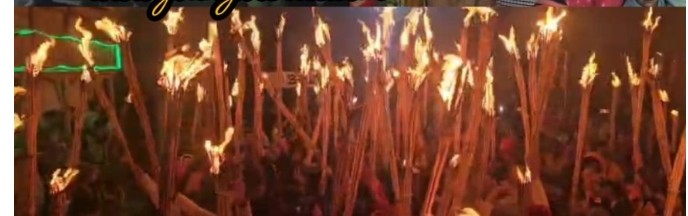
In the trans-Giri region of Sirmaur, Diwali has an entirely different character. At Barol village, men assembled at the temple around 4 a.m. on Monday and, after invoking local gods and goddesses, circumambulated the entire village carrying burning torches.
The traditional Mashaal Yatra is believed to invoke divine blessings for prosperity, peace and protection. Only men participate in the procession, which continues to be observed with devotion despite changing lifestyles. Local Panchayat head Anil Sharma said villagers were determined to preserve the ancestral custom and pass it on to younger generations.
Another unusual tradition survives in Sammu village of Bhoranj subdivision in Hamirpur district, where residents do not celebrate Diwali. According to an age-old local belief, a woman who committed sati centuries ago cursed the village against celebrating the festival for seven generations.
Local accounts narrate that the woman was returning to her parental home with her son when soldiers informed her about her husband’s death in battle. She subsequently committed sati along with her son and her husband’s belongings, leaving behind the curse.
Villagers continue to honour her memory by worshipping her statue, reportedly preserved in every household. Residents recall instances when attempts to celebrate Diwali allegedly resulted in fires, illness and other misfortunes. Even the worship ritual has its own restrictions: if a guest unexpectedly arrives during the ceremony, it is considered ineffective and must be performed again.
The younger generation continues to follow the tradition, regarding it as an inherited obligation.
The cultural calendar of Himachal also extends Diwali celebrations by nearly a month through Budhi Diwali, particularly in the interior regions of Sirmaur, Shimla and Kullu.
It is observed in Anni and Nirmand in Kullu, Chopal in Shimla district and Rajgarh, Sangrah and Shillai in Sirmaur. The festivities generally continue for four to five days, bringing together entire village communities through traditional torch processions, folk music, dances, bonfires, temple ceremonies and community feasts. They also burn bonafire interno called Dawalttha.
The Mashaal Yatra, in which villagers carry burning torches made from deodar and pine wood, remains one of the most distinctive features of Budhi Diwali. Traditional Nati, Budechu and Limber dances, folk songs and fairs accompany the celebrations. In some localities, the festivities also involve the worship of village deities and elaborate community gatherings.
Local folklore offers an interesting explanation for this month-long delay. It is believed that when Lord Rama returned to Ayodhya after defeating Ravana, news of his return took nearly a month to reach remote Himalayan settlements.
Another explanation suggests that villagers were occupied with agricultural activities during the mainstream festival and therefore decided to celebrate after completing their seasonal work. Over generations, the delayed celebration acquired its own identity as Budhi Diwali.
In several other parts of the state, Devtaon is organised eight days after Diwali, when villagers assemble to worship their presiding deities. Traditional palanquins of local gods are brought out, religious ceremonies are performed and devotees gather to seek blessings for their families and communities.
The diversity of festive traditions is also reflected in Baijnath town of Kangra district, where the burning of Ravana’s effigy on Dussehra is traditionally avoided. Unlike most parts of the country, residents here consider Ravana a great devotee of Lord Shiva rather than merely a symbol of evil. According to local legend, Ravana performed severe penance to please Lord Shiva and offered his ten heads in devotion. Pleased with his worship, Shiva granted him a Shivling to carry to Lanka, with the condition that it should not be placed on the ground. During the journey, Ravana handed the Shivling to a shepherd at Baijnath, but it became permanently established at the spot. The famous Baijnath Shiva temple is associated with this legend. Out of reverence for Ravana’s devotion, residents traditionally refrain from celebrating Dussehra or burning his effigy.
These contrasting customs illustrate how geographical isolation, limited communication in earlier centuries, agricultural cycles and local religious beliefs shaped the cultural calendars of Himachal’s mountain communities. The time taken for news and traditions to travel across difficult terrain allowed settlements to develop and preserve their own rituals and forms of celebration.
Improved connectivity, migration and modern lifestyles have brought these communities closer to mainstream society, but their distinctive customs continue to survive. From a village that celebrates Diwali with torches at four in the morning to another that waits a month, and a town that refuses to burn the effigy of Ravana, Himachal Pradesh offers a remarkable mosaic of India’s living folk traditions and civilisational heritage.
About the Author

Himachal ki har badi khabar, sabse pehle aapke paas
Breaking news, local updates aur exclusive stories — seedha WhatsApp ya Email par. Free. No spam.
WhatsApp Alerts
Instant news seedha aapke phone par. Ek click me subscribe karein.
Subscribe on WhatsAppEmail Newsletter
Har nayi post ka link aapke inbox me. Kabhi bhi unsubscribe karein.