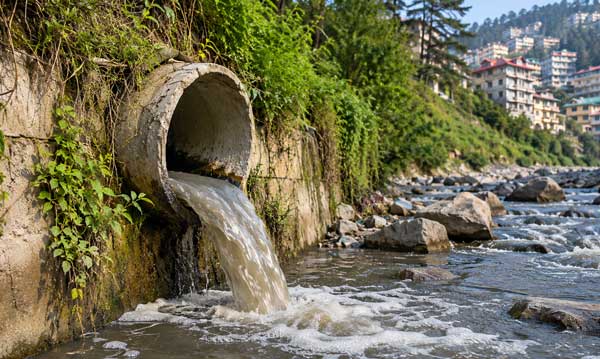
Photo used for indicative purpose only. Source AI
Combermere’s Lift Nullah records BOD more than seven times above permissible limit; findings put fresh questionmark over Shimla’s sewage management and pollution control
Shimla,/ New Delhi, Nov 26,
Nearly three years after proceedings were initiated over pollution in Ashwani Khad, fresh water-quality monitoring has identified two locations in its drainage network where organic pollution levels remain significantly elevated, with Combermere’s Lift Nullah recording Biochemical Oxygen Demand (BOD) of 22.4 mg/L against the prescribed limit of 3 mg/L.
A second monitoring point, Lift Nullah near the waste-processing site, recorded BOD of 16 mg/L, more than five times the prescribed limit. The findings form part of a comprehensive assessment submitted by the Himachal Pradesh State Pollution Control Board (HPSPCB) before the National Green Tribunal (NGT), which heard the matter on November 25.
The finding may raise question marks about the effectiveness of sewage management and wastewater monitoring in Shimla, particularly as the authorities continue to identify pollution sources in a drainage system receiving wastewater from several parts of the city.
The Pollution Control Board collected samples from 25 locations across Ashwani Khad and its tributaries on September 29, 30 and October 1 this year. The samples were analysed at the NABL-accredited State Board Laboratory in Shimla.
While Dissolved Oxygen levels and pH remained within prescribed limits at all 25 locations, BOD exceeded the permissible limit at the two Lift Nullah monitoring points. The Board has attributed the elevated readings to organic pollution loads and stated that the locations warrant further investigation to identify possible wastewater discharge sources.
The monitoring also recorded faecal coliform concentrations of 920 MPN/100 ml at Lift Nullah before its confluence with River Ashwani and 540 MPN/100 ml downstream. Although the Board reported these readings to be within prescribed limits, their relatively high concentrations have also been flagged for further investigation.
The findings are important in the context of the continuing NGT proceedings. In February 2026, the Tribunal had observed that the latest water-quality report on Ashwani Khad was not available on record, making it difficult to ascertain whether pollution levels had improved. The November assessment now provides a more detailed picture of water quality across 25 locations in the Shimla catchment.
The report has also identified compliance gaps in the city’s sewage treatment infrastructure. Although STPs at Dhalli, Lalpani and Malyana generally showed satisfactory treatment performance for pH, BOD, COD, Total Suspended Solids and faecal coliform, Total Nitrogen levels in most of these plants were found non-compliant with norms prescribed by the NGT in another environmental case.
The Pollution Control Board has identified 13 sewage treatment facilities and establishments with the potential to generate domestic sewage or trade effluent in the catchment. These include automobile service stations, the Municipal Corporation’s slaughterhouse at Krishna Nagar, APG University, AIMS at Chamiyana and captive sewage treatment facilities.
Also read:NGT pulls up HP over untreated sewage flowing into Rivers, issues 32-point action plan
However, the report does not establish that these establishments are responsible for the pollution recorded at the two monitoring points.
During the hearing, the Regional Officer of HPSPCB, Shimla, admitted that the report did not specifically clarify whether the discharges listed against the identified establishments were treated sewage and trade effluent. He sought additional time to examine and clarify the position.
The Department of Jal Shakti also sought two weeks to submit a progress report on the construction and laying of the sewage network.
Meanwhile, Shimla Jal Prabandhan Nigam Limited informed the Tribunal that a statement made during the September 1 hearing had inadvertently been given without complete information. The Tribunal allowed its withdrawal and granted the agency two weeks to file its reply.
Another infrastructure concern relates to the proposed 3.1 MLD sewage treatment plant at Dogra Bridge in Panthaghatti. According to SJPNL’s submission, only 10 per cent of the construction work had been completed, against a target date of March 2027.
Himachal Scape contacted the Regional Office of the HPSPCB, Shimla, via phone call and message seeking clarification on three specific aspects of the findings: whether the Board had traced the source responsible for the elevated BOD level at Combermere’s Lift Nullah, the nature of the discharge entering Lift Nullah near the waste-processing site, and the reasons behind Total Nitrogen non-compliance in most of the monitored sewage treatment plants. However, no response had been received from the Regional Office till the filing of this report. The Board’s response, if received, will be incorporated accordingly.
Meanwhile as per NGT directive the HPSPCB has been asked to continue identifying pollution sources, particularly around locations recording elevated BOD and faecal coliform levels, and verify wastewater discharge pathways and the functioning of treatment facilities. It has also been directed to initiate appropriate remedial and regulatory action wherever violations or unauthorised discharges are established.
The NGT has listed the matter for further hearing on March 5, 2027.
About the Author

Himachal ki har badi khabar, sabse pehle aapke paas
Breaking news, local updates aur exclusive stories — seedha WhatsApp ya Email par. Free. No spam.
WhatsApp Alerts
Instant news seedha aapke phone par. Ek click me subscribe karein.
Subscribe on WhatsAppEmail Newsletter
Har nayi post ka link aapke inbox me. Kabhi bhi unsubscribe karein.