47 Quintal plastic dump into Pong dam every rainy season HC increases the scope of PIL to Renuka & Chander Tal
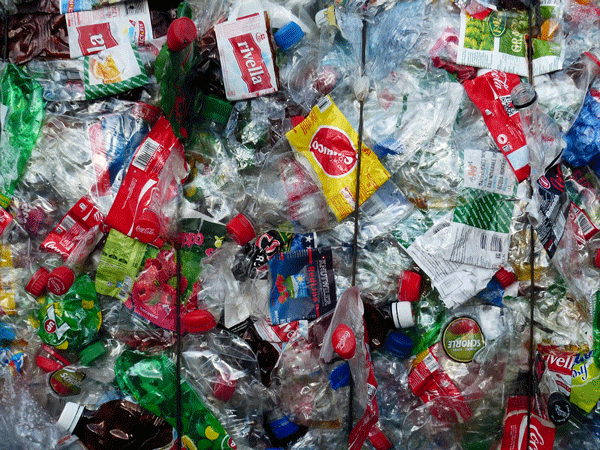
Photo source: Internet
47 Quintal plastic dump into Pong dam every rainy season HC increases the scope of PIL to Renuka & Chander Tal
Shimla, July 23,
Himachal Pradesh High Court has expanded the scope of an ongoing public interest litigation (PIL) concerning the conservation of wetlands by directing the state government to submit detailed reports on the ecological protection and management of all three Ramsar sites in Himachal Pradesh—Pong Dam Lake, Renuka Wetland and Chandar Tal. The court while hearing the PIL on July 16 also sought comprehensive information on pollution, illegal encroachments, poaching, illegal cultivation and measures taken to protect migratory birds and wildlife inhabiting these internationally recognised wetlands.
The division bench of Chief Justice G.S. Sandhawalia and Justice Bipin C. Negi was informed through an affidavit filed by the Chief Conservator of Forests that 47.08 quintals of plastic waste had been collected from Pong Dam Lake during the last three financial years.
The Forest Department stated that most of the plastic waste reaches the wetland through flash floods during the monsoon season and is removed regularly before being disposed of according to government norms. Soil conservation works, including construction of brushwood check dams, are also being undertaken to reduce silt flow into the wetland.
The affidavit further revealed that the annual waterbird census conducted on January 31 and February 1 this year recorded 1,24,344 birds belonging to 115 species at Pong Dam Lake, underlining its importance as one of India’s premier wintering grounds for migratory waterfowl.
To improve breeding success, the Forest Department has protected breeding sites of migratory birds, including Sarus Cranes, by constructing earthen mounds at Jakhra Palli. Similar nesting habitats are also being created for vultures, while regular patrolling is being carried out to safeguard breeding colonies.
Awareness campaigns involving local residents and school children are also being organised every year to promote wildlife conservation.
To curb illegal activities, the department informed the court that drone surveillance is being conducted over the Pong Dam Wildlife Sanctuary to monitor illegal cultivation, grazing and encroachments.
Anti-poaching and anti-grazing squads have also been deployed in and around the sanctuary. During inspections, temporary fencing and illegal sheds erected inside the protected area were removed, while 115 damage reports were issued against offenders during 2025-26 and compensation amounting to Rs 4.70 lakh was recovered for violations under the Wildlife (Protection) Act.
The department claimed that no poaching case had been reported during 2025-26, though the High Court observed that it was not inclined to accept the claim without further examination.
The bench also expressed dissatisfaction over the status report, observing that it did not disclose the number of trees planted under plantation drives, their survival rate or whether encroachers had been penalised or directed to pay compensation. It directed the Forest Department to furnish complete details before the next hearing.
The court simultaneously widened the PIL to examine environmental concerns at Renuka Wetland and Chandar Tal, noting that along with Pong Dam they are Himachal Pradesh’s three Ramsar sites recognised under the Ramsar Convention.
The Amicus Curiae informed the court that Renuka Lake is home to endangered species such as the Golden Mahseer, Black Spotted Turtle, Indian Softshell Turtle and Himalayan Black Bear besides supporting 103 bird species.
The Amicus Curiae further pointed out that the Renuka Fair had caused serious environmental degradation due to indiscriminate dumping of garbage, inadequate sanitation, burning of waste and dumping of refuse into the Giri River.
The report also highlighted excessive sound pollution, stating that loudspeakers and entertainment programmes generated noise levels of 110 to 120 decibels, far above the safe threshold of 85 decibels, disturbing migratory birds and wildlife around the sanctuary. It recommended that core wildlife areas be sealed during the fair, strict penalties be imposed for violations and vendors be made responsible for cleaning the site after the festival.
Taking note of these concerns, the High Court directed the Deputy Commissioner, Sirmaur, to submit a detailed status report on pollution, waste management and protection of wildlife at Renuka Wetland.
It also directed the Forest Department to furnish details of wild animals that had been rescued but remained in captivity instead of being released back into their natural habitat, not only at Renuka but across the state.
Fresh compliance reports were also sought from the Deputy Commissioner, Kangra, regarding earlier directions relating to Pong Dam. The matter has been listed for hearing on September 1, 2026.
The PIL itself was registered by the High Court after taking suo motu cognisance of reports highlighting threats to the Pong Dam Ramsar site. One of the incidents that prompted judicial intervention involved the death of cattle in a landmine blast allegedly laid by poachers operating around the wetland, indicating the serious nature of illegal hunting and fishing activities in the protected area.
Since then, the court has been continuously monitoring issues relating to encroachments, illegal cultivation, grazing, pollution and conservation of the internationally important wetland ecosystem.
About the Author