New districts, old politics: Sukhu under fire
Shimla, Oct 19,
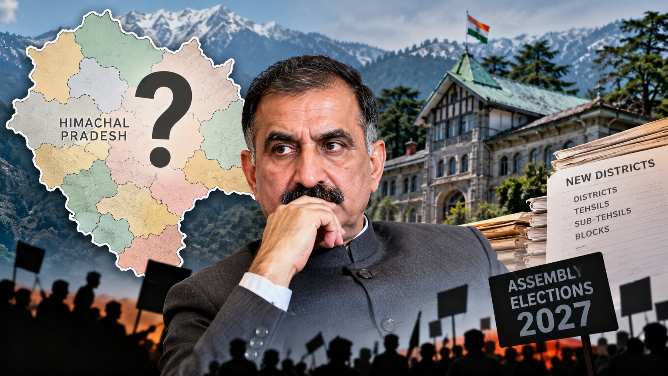
The Himachal Pradesh government’s proposal to examine the creation of new districts has opened another political front for Chief Minister Sukhvinder Singh Sukhu, with the Opposition questioning the timing and financial implications of the exercise ahead of the 2027 Assembly elections.
Whether the move will eventually improve governance or prove difficult to justify is a question that only time will answer. For now, however, the proposal is attracting criticism even before the commission examining administrative reorganisation has submitted its recommendations.
The government has defended the initiative as an exercise in administrative reform. Sukhu has said that geographical conditions and population will be considered while examining the need for changes. A four-member commission headed by retired Himachal Pradesh High Court judge Justice Dharam Chand Chaudhary has been tasked with reviewing the existing administrative structure, including districts, tehsils, sub-tehsils and development blocks.
The commission has six months to submit its report, placing the exercise within a politically sensitive period as Himachal moves towards its next Assembly elections.
Timing fuels political questions
The BJP has questioned the government’s intentions, alleging that the proposal could be politically motivated. The Opposition has also raised concerns about the state’s financial position and argued that the government should focus on existing commitments and improving public services.
The government, meanwhile, maintains that administrative requirements will guide the exercise. At this stage, neither the criticism nor the government’s explanation settles the larger question of whether creating new districts is necessary or financially sustainable.
The timing, however, makes the issue difficult to separate from politics. If the commission submits its report around April 2027, its recommendations could become part of the political debate in the months preceding the Assembly elections. Any subsequent decision will therefore face scrutiny over both its administrative merit and its possible electoral implications.
Expectations versus expenditure
In a geographically challenging state such as Himachal Pradesh, distance from district headquarters can make access to government services difficult, particularly for residents of remote areas. Bringing administration closer to people could offer genuine benefits if supported by adequate infrastructure and staffing.
But creating a district involves much more than announcing a new headquarters. Offices, personnel, buildings and recurring administrative expenses would all have to be considered. The government would need to establish how the proposed changes would improve service delivery and whether those benefits justify the additional expenditure.
The exercise could also revive long-standing demands from areas seeking district status. Such aspirations may reflect genuine administrative difficulties, but not every demand can necessarily be accommodated. Decisions on which areas qualify, and which do not, could themselves become politically contentious.
A new district, by itself, does not guarantee better governance. Without adequate resources and functioning institutions, the creation of additional administrative units could increase expenditure without delivering the expected improvements.
The real test lies ahead
It is too early to declare the proposal either a necessary reform or an election-year exercise. The commission has yet to complete its assessment, and the government has not announced a final decision to create new districts.
The real test will be whether the recommendations offer a clear administrative rationale, a credible financial assessment and measurable benefits for residents.
For Sukhu’s government, the challenge is to demonstrate that the exercise is driven by public need rather than political convenience. For the Opposition, the challenge is to scrutinise the proposal on its merits rather than rely solely on allegations about its timing.
The question before Himachal is not simply how many new districts it needs, but whether any proposed change can make governance more accessible, efficient and financially sustainable. The answer will emerge through the commission’s findings and the decisions that follow—not through political claims alone.
About the Author

Himachal ki har badi khabar, sabse pehle aapke paas
Breaking news, local updates aur exclusive stories — seedha WhatsApp ya Email par. Free. No spam.
WhatsApp Alerts
Instant news seedha aapke phone par. Ek click me subscribe karein.
Subscribe on WhatsAppEmail Newsletter
Har nayi post ka link aapke inbox me. Kabhi bhi unsubscribe karein.