Shimla, Nov 27,
After its earlier attempt to impose a water cess on hydropower generation triggered a prolonged political and legal controversy, the Himachal Pradesh government has adopted a different strategy to harness the economic potential of its abundant water resources by introducing a uniform pricing mechanism for the sale of surplus raw water to neighbouring States, government agencies and industries.
The decision marks a shift towards recognising water not merely as a natural resource flowing through the State but also as an economic asset capable of generating revenue, particularly at a time when several neighbouring regions face mounting challenges in securing drinking and irrigation water during the summer and winter months.
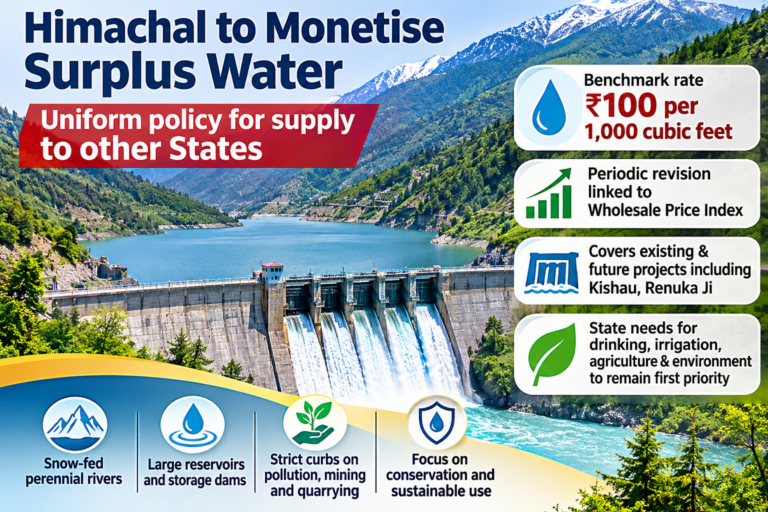
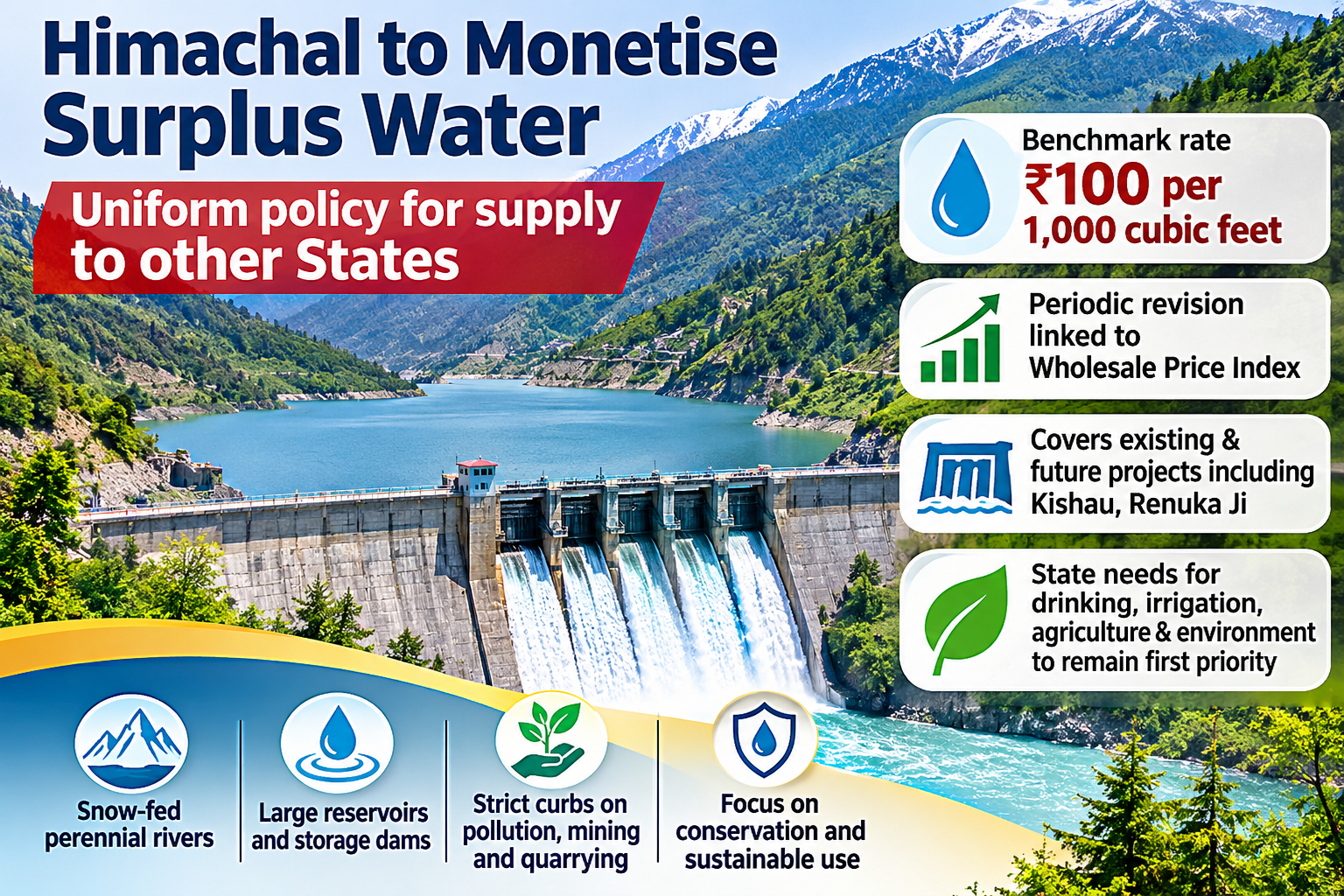
The Sukhvinder Singh Sukhu government has approved a State-wide policy fixing an initial benchmark rate of Rs 100 per 1,000 cubic feet for surplus raw water supplied from existing and future water projects. The rates will be periodically revised in accordance with the Wholesale Price Index (WPI), providing a mechanism to protect the economic value of water against inflation.
The policy, however, makes the State’s own requirements paramount and excludes water utilised for domestic purposes within Himachal Pradesh. Supply to other States and eligible agencies will be considered only after meeting the present and future requirements of the State.
The initiative assumes particular importance in the context of Himachal Pradesh’s geographical advantage as an important catchment of the Indus and Ganga river systems. Its perennial, snow-fed rivers and glacial watersheds sustain extensive downstream regions, while its reservoirs and multipurpose projects store substantial volumes of water for drinking, irrigation and other requirements.
Although five major river systems traverse the State, the economic potential of their water discharge has remained a largely underutilised resource from the perspective of direct revenue generation. Himachal Pradesh also supplies water through major storage and distribution systems that serve its own population of approximately 75 lakh, besides contributing to the water security of millions of people downstream.
The government has increasingly sought to protect these resources through stricter environmental safeguards, including pollution-control measures and restrictions on mining and quarrying in vulnerable river systems and water bodies. The latest policy appears to extend that approach from conservation towards economic valuation.
The Kishau Multipurpose Project provides an important context for the decision. Himachal Pradesh has an allocated share equivalent to 3.154 per cent of the dam’s live storage, estimated at approximately 42 million cubic metres. The State also has an allocated share of Yamuna waters under the Memorandum of Understanding among the Upper Yamuna Basin States, which envisages the development of Lakhwar, Kishau and Renuka Ji dam projects for optimum utilisation of the basin’s water resources.
The new pricing framework is expected to provide a uniform basis for determining the economic value of surplus water from these projects, including the proposed Kishau and Renuka Ji dams, as well as other existing and future inter-State water projects.
Chief Minister Thakur Sukhvinder Singh Sukhu said the policy was aimed at protecting the State’s natural resources and ensuring appropriate economic returns from its valuable water assets.
He maintained that drinking water, irrigation, agricultural, environmental and developmental requirements of Himachal Pradesh would remain the foremost consideration before any surplus water was made available to other States.
The policy potentially opens a new avenue for resource-based revenue generation for a hill State whose financial dependence on hydropower royalties, central assistance and limited conventional revenue sources has remained a persistent economic challenge.
However, its actual revenue potential will depend on the availability of surplus water, inter-State agreements, infrastructure for storage and transportation, and the willingness of recipient States to accept the proposed pricing mechanism.
The larger policy challenge for Himachal Pradesh will be to reconcile its ecological responsibility as an upstream water-rich State with the growing demand for water security in the northern plains, while ensuring that its natural wealth translates into tangible economic benefits for its people.
About the Author

Himachal ki har badi khabar, sabse pehle aapke paas
Breaking news, local updates aur exclusive stories — seedha WhatsApp ya Email par. Free. No spam.
WhatsApp Alerts
Instant news seedha aapke phone par. Ek click me subscribe karein.
Subscribe on WhatsAppEmail Newsletter
Har nayi post ka link aapke inbox me. Kabhi bhi unsubscribe karein.