State spends over 90% of expenditure on revenue items; committed liabilities consume 88% of receipts against 52% national average
Shimla, Nov 24,
Himachal Pradesh’s fiscal problems appear more pronounced when its financial indicators are compared with the National average, with the state lagging on revenue mobilisation, carrying a substantially higher debt burden and spending a disproportionate share of its income on recurring obligations, according to the latest report of PRS Legislative Research.
The State of State Finances 2026–27 report presents a revealing comparison of the state’s financial position with the consolidated finances of States across the country, showcasing the limited revenue flexibility available to Himachal for undertaking developmental expenditure.
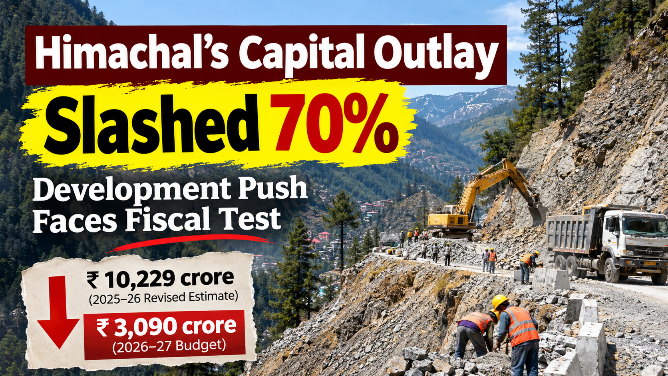
One of the most striking findings relates to the composition of government expenditure. Himachal Pradesh is among the states estimated to spend 90% or more of its total expenditure on revenue items during 2026–27, compared with the all-state average of 82%. This leaves a relatively smaller proportion for capital investment and the creation of durable public assets such as roads, bridges, hospitals and other infrastructure.
The difference becomes even more pronounced when committed expenditure is examined. Himachal has budgeted Rs 35,641 crore towards salaries, pensions and interest payments in 2026–27, equivalent to 88% of its estimated revenue receipts. In comparison, states collectively have budgeted around 52% of their revenue receipts towards these commitments.
The state’s own revenue-generating capacity also remains below the National average. Himachal’s own-tax revenue is estimated at 5.5% of its Gross State Domestic Product (GSDP), against an all-state average of 7%. States such as Maharashtra (7.7%), Punjab (7.2%) and Karnataka (6.7%) have higher own-tax revenue relative to their respective GSDPs.
The gap indicates the challenge Himachal faces in mobilising resources internally to finance its expenditure requirements, particularly when central grants and other transfers remain important components of its revenue. Noteworthy that this where the recent court cases win by current Sukhu government will contribute in days to come.
Debt is another area of concern. Himachal’s outstanding liabilities are estimated at 40.5% of GSDP by the end of 2026–27, substantially higher than the consolidated debt ratio of approximately 28% for states. Along with Arunachal Pradesh, Nagaland and Punjab, Himachal belongs to the group of four states whose outstanding liabilities exceed 40% of GSDP.
The revenue deficit position further highlights the difference. Himachal has budgeted a revenue deficit of 2.4% of GSDP for 2026–27, against a consolidated revenue deficit of approximately 0.2% of GDP for all states. A revenue deficit indicates that revenue receipts are insufficient to meet recurring revenue expenditure, requiring the government to finance the gap through borrowing.
The report also highlights the state’s comparatively modest allocation towards unconditional cash transfers. Himachal has estimated expenditure on such schemes at around 2% of its revenue receipts, while several states, including West Bengal, Andhra Pradesh and Telangana, allocate more than 10%.
This suggests that unconditional cash transfers, often a subject of debate in discussions on state finances, account for a relatively small share of Himachal’s revenue receipts compared with several other states.
Taken together, these indicators point towards a structural challenge in Himachal’s public finances. The state is carrying a higher debt burden, generating a lower proportion of its GSDP through own-tax revenue and committing a substantially larger share of its revenue receipts to salaries, pensions and interest payments than the national state average.
For a hill state with substantial infrastructure requirements and geographical constraints, the limited fiscal space makes the task of balancing recurring obligations with long-term development investment particularly important.
The PRS analysis therefore brings into focus a larger question concerning Himachal’s financial sustainability: how can the state expand its development investment and infrastructure base while simultaneously managing its debt and meeting its existing expenditure commitments?
About the Author

Himachal ki har badi khabar, sabse pehle aapke paas
Breaking news, local updates aur exclusive stories — seedha WhatsApp ya Email par. Free. No spam.
WhatsApp Alerts
Instant news seedha aapke phone par. Ek click me subscribe karein.
Subscribe on WhatsAppEmail Newsletter
Har nayi post ka link aapke inbox me. Kabhi bhi unsubscribe karein.