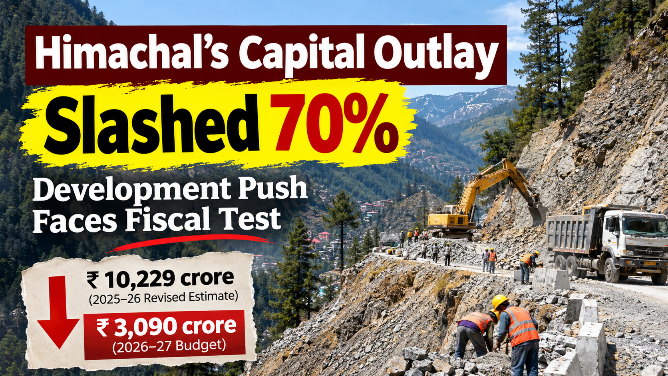
PRS analysis showcases sharp reduction in asset-creation budget; allocation falls from Rs 10,229 crore in revised estimates to Rs 3,090 crore for 2026–27
Shimla, Nov 24,
Political claims of development are best tested against budgetary priorities. And Himachal Pradesh’s latest financial projections present a rather contrasting picture, with capital investment budgeted to fall by 70% in 2026–27.
This figure is raising concerns over the state’s capacity to sustain infrastructure development amid mounting fiscal pressures.
According to the State of State Finances 2026–27 report published by PRS Legislative Research, the state’s capital outlay has been pegged at Rs 3,090 crore for the current financial year, against Rs 10,229 crore in the revised estimates for 2025–26. This represents a decline of Rs 7,139 crore.
Capital outlay is the expenditure incurred by the government towards creating durable public assets, including roads, bridges, hospitals, schools and irrigation infrastructure. A substantial reduction in this component can constrain the State’s ability to expand infrastructure and undertake new development projects.
The figures assumes importance in view of Himachal’s geographical and developmental requirements, where road connectivity, disaster-resilient infrastructure, healthcare facilities and water supply projects require sustained public investment. Also weather change is posing its own unique challanges in such a situation.
However, the comparison also needs to be seen against the unusually high revised estimates for 2025–26. Capital outlay during that year was revised upwards by 160% from the original budget provision of Rs 3,941 crore. The proposed allocation of Rs 3,090 crore for 2026–27 is therefore around 22% below the original budget estimate for 2025–26.
The PRS report also highlights the state’s overwhelming dependence on revenue expenditure. Himachal is among the states estimated to spend 90% or more of its total expenditure on revenue items in 2026–27, compared with the all-state average of 82%.
Revenue expenditure largely comprises recurring obligations such as salaries, pensions, interest payments, subsidies and administrative expenses, which do not directly create public assets.
The state’s committed expenditure is another source of concern. Interest payments, salaries and pensions together are estimated to consume 88% of its revenue receipts, leaving limited fiscal flexibility for other developmental priorities.
The report further points out that Himachal has not budgeted any receipts under the Centre’s Scheme for Special Assistance to States for Capital Investment (SASCI) in 2026–27. The scheme provides 50-year interest-free loans to states for capital investment, making it an important source of support for infrastructure creation.
The absence of budgeted SASCI assistance could further limit the state’s options for financing capital projects.
Here it is pertinent to mention that Himachal’s wider fiscal position also remains under pressure. The state has budgeted a revenue deficit of 2.4% of its Gross State Domestic Product (GSDP) and a fiscal deficit of 3.5% for 2026–27. Its outstanding liabilities are estimated to remain above 40% of GSDP, placing it among four states with debt levels exceeding this threshold.
The PRS analysis suggests that the challenge before Himachal is not merely managing its accumulated debt but also creating sufficient fiscal space to finance development while meeting its existing expenditure commitments.
With a large proportion of revenue already committed to recurring expenses, the reduction in capital outlay brings the question of infrastructure investment into sharper focus.
The state government’s ability to mobilise additional resources, improve its own revenue generation and secure central assistance will be crucial in determining whether planned development works can be sustained during the year.
Source: PRS Legislative Research, State of State Finances 2026–27; Himachal Pradesh Budget Analysis 2026–27.
About the Author

Himachal ki har badi khabar, sabse pehle aapke paas
Breaking news, local updates aur exclusive stories — seedha WhatsApp ya Email par. Free. No spam.
WhatsApp Alerts
Instant news seedha aapke phone par. Ek click me subscribe karein.
Subscribe on WhatsAppEmail Newsletter
Har nayi post ka link aapke inbox me. Kabhi bhi unsubscribe karein.