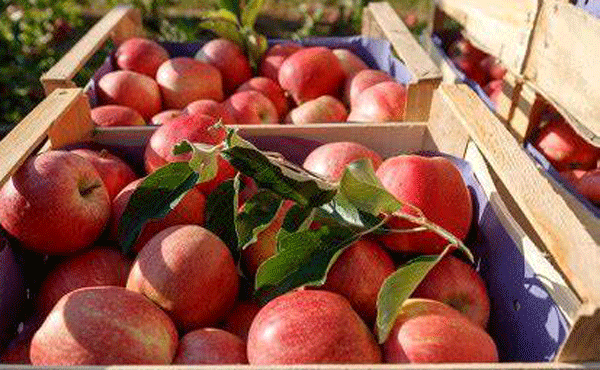
Photo used for indicative purpose only. Source: Internet
Shimla, Jan 29,
The India–European Union Free Trade Agreement (FTA), which reduces the import duty on apples from 50 per cent to 20 per cent, has triggered serious concern among apple growers in Himachal Pradesh, with orchardists warning that the deal could destabilise the livelihood of over 2.5 lakh families dependent on the state’s Rs 55-billion apple economy.
Growers fear that the duty cut will sharply increase apple imports into India, leading to price suppression in domestic markets and making Himachali apples unviable against cheaper foreign produce. The impact is expected to extend beyond Himachal to apple-producing regions of Jammu and Kashmir and Uttarakhand.
‘Direct threat to domestic apple industry’
Reacting to the agreement signed on January 27 between India and the “European Union”, the Himachal Pradesh Apple Growers Association termed the decision “deeply damaging” for Indian orchardists.
“A reduction in import duty at a time when production costs are rising has created a crisis for apple growers. Once cheaper EU apples enter Indian mandis in bulk, domestic apples will not fetch fair prices,” said Rakesh Singha, President of the association.
Lokendra Bisht, President of the Progressive Growers Association, echoed similar concerns, stating that Himachali apples would struggle to compete with subsidised, high-yield foreign produce.
“This will push local apples out of major markets. Growers here simply cannot match the cost advantage enjoyed by European producers,” he said.
Imports set to rise under FTA
According to the agreement, 50,000 tonnes of apples will initially be imported from the EU, with the quantity expected to increase to 1 lakh tonnes annually over the next 10 years. These imports will attract a 20 per cent customs duty, with a minimum import price (MIP) fixed at Rs 80 per kg. The agreement is scheduled to come into effect in 2027.
Apple imports currently attract a 50 per cent duty. In 2024, India imported around 5.19 lakh tonnes of apples, with Iran accounting for about 26 per cent, Turkey 23 per cent, Afghanistan 8.2 per cent, and the EU already contributing over 11 per cent. Growers warn that the EU’s share will rise significantly once the duty cut takes effect.
Why this matters
-Domestic apple growers require Rs 50–100 per kg to remain profitable
– Cost of production in Himachal is around Rs 27 per kg
– Cheaper imports could push market prices below sustainable levels
Political concerns and broken promises
Congress MLA from Theog, Kuldeep Singh Rathore, accused the Centre of repeatedly weakening safeguards for hill farmers.
“First the import duty on New Zealand apples was reduced, and now the same has been done for EU apples. If this continues, the livelihoods of more than 2.5 lakh families will be threatened,” Rathore said, urging BJP leaders from Himachal to raise the issue with the Centre.
Growers have also recalled Prime Minister”Narendra Modi’s, 2014 election promise made in Sujanpur, Hamirpur, to raise apple import duty to 100 per cent. “Instead of increasing the duty, it has been steadily reduced,” orchardists said.
Unequal global competition
Himachal Pradesh produces 7–8 tonnes of apples per hectare, compared to 40–70 tonnes per hectare in countries such as New Zealand, China, the US and Iran due to favourable geography, advanced technology and mechanisation.
“With such vast productivity gaps, competition is inherently unequal. Without adequate protection, Indian growers cannot survive,” apple growers’ bodies said.
Growing unrest among orchardists
The announcement has already sparked protests, with apple growers demonstrating outside the state secretariat last week. Orchardists fear that under the EU and New Zealand FTAs, other exporting nations will also demand duty concessions, further opening Indian markets to low-priced imports.
What is being projected nationally as a landmark trade achievement, growers warn, could ultimately turn into the “mother of all problems” for apple growers in Himachal Pradesh and other hill states unless corrective safeguards are introduced.
About the Author

The HimachalScape Bureau comprises seasoned journalists from Himachal Pradesh with over 25 years of experience in leading media conglomerates such as The Times of India and United News of India. Known for their in-depth regional insights, the team brings credible, research-driven, and balanced reportage on Himachal’s socio-political and developmental landscape.