


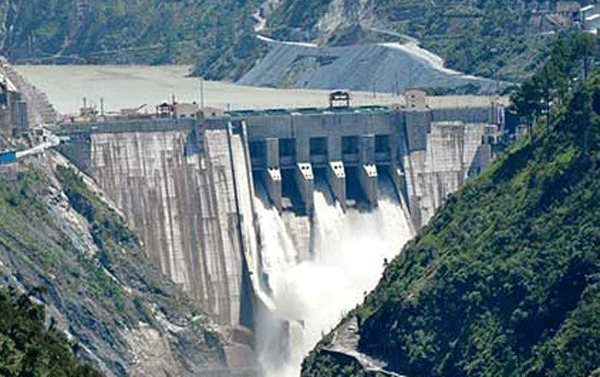
Photo used for indicative purpose only. Source internet
Shimla, Aug 5,
In a ruling with far-reaching implications for land governance and environmental protection in Himachal Pradesh, the High Court on Tuesday struck down Section 163-A of the Himachal Pradesh Land Revenue Act, 1954, declaring it unconstitutional. This section had allowed for the regularisation of encroachments on government land. The judgment, delivered by a division bench of Justice Vivek Singh Thakur and Justice Bipin Chander Negi, directed the state to initiate eviction proceedings against all such encroachments that were to be covered under the now-defunct provision.
The verdict came in the long-pending writ petition Poonam Gupta vs State of Himachal Pradesh, filed 23 years ago challenging the constitutional validity of Section 163-A. Introduced in 2002 during the first tenure of Chief Minister Prem Kumar Dhumal, the section enabled the government to frame rules for regularising encroachments, with the stated aim of helping small and marginal farmers.
But the court ruled that the provision violated Article 14 of the Constitution, which guarantees equality before law, and attempted to legitimise illegal acts. “The impugned provision is in fact legislation for a class of dishonest persons. Equality cannot be claimed in illegality,” the bench stated in its judgment.
Court calls regularisation a reward for criminal trespass
The judges emphasised that deliberate and voluntary encroachments amount to criminal trespass under Section 441 of the Indian Penal Code, and such acts cannot be regularised by any statute. Citing precedents laid down by the Supreme Court, the court drew a clear line between involuntary encroachments arising from dire poverty and premeditated land grabbing for personal gain.
Referring to state government records, the court noted that over 1.23 lakh hectares of land had been encroached upon in Himachal Pradesh, and 1.67 lakh applications were filed under Section 163-A seeking regularisation. The court observed that the provision had effectively encouraged land grabbing, dishonesty, and a disregard for environmental and legal safeguards.
A violation of public trust and environmental duty
Quoting from the doctrine of public trust, the court underlined the constitutional responsibility of both the State and its citizens to protect natural resources. In a stinging observation, the bench remarked: “Failure to remove encroachments and protect government land is a failure in governance. It promotes dishonesty and undermines the rule of law.”
The court stated that public resources—rivers, forests, mountains, and land—belong to the people and are not the property of the government to distribute at will. “These resources must be safeguarded for future generations. Regularisation of forest land for orchards or private use defeats the very purpose of ecological conservation,” the bench said, invoking the principles of sustainable development and intergenerational equity.
Misuse of public sympathy to justify illegality
The bench dismantled the State’s claim that Section 163-A aimed to uplift the poor and marginalised, noting that existing schemes already address landlessness, such as the H.P. Grant of Land to Landless Persons. It warned against the misuse of public sympathy to protect illegal acts. “A claim to public interest cannot override the law. Select individuals who violate the law cannot be granted special protection under the guise of poverty or marginalisation,” the court observed.
It also called out the State’s contradictory stance, pointing to how Section 163 penalises encroachments, while Section 163-A allowed their regularisation. The court termed this “excessively contradictory and mutually destructive”, and said such legislative contradictions weaken the rule of law.
Officials to be held accountable for inaction
The court reiterated its earlier directions issued in PIL No. 17 of 2014 and PIL No. 9 of 2015, where it had ordered the State to act against encroachments and hold officials accountable for failure to do so. These directions will continue to remain in force. Officials of the revenue, forest, and public works departments who do not act against encroachments will now face disciplinary, civil, and criminal proceedings.
During the hearing, it was submitted that the State had withdrawn its 2017 proposal to introduce fresh rules for regularisation and currently has no policy in place to revive the struck-down law. The court noted that several stay orders in similar cases had been granted earlier, based on the pending draft rules.
Adverse possession laws called ‘archaic and irrational’
The court also delved into the legal doctrine of adverse possession, criticising it as outdated and illogical. It said, “Rewarding a trespasser merely for occupying land illegally for 12 years is both morally and legally indefensible. Such laws need reconsideration by the legislature as they legitimise dishonesty.”
The ruling is expected to trigger political and legal ripples across the state, particularly because thousands of applicants had filed affidavits admitting to encroachments, hoping for regularisation. With the legal provision now struck down, they face the prospect of eviction, penalties, and possible criminal proceedings.
Directions for eviction and restoration of land
In its final directions, the court ordered the State and competent authorities to carry out eviction proceedings as per law, following the timeline prescribed by the Additional Chief Secretary (Revenue). The court instructed that illegal structures must be removed, fencing be undertaken, and forest cover restored wherever necessary.
Concluding firmly, the bench stated: “The court cannot remain a silent spectator while public land is grabbed in connivance with officials. This would amount to destroying democratic institutions and endorsing anarchy.”
About the Author

The HimachalScape Bureau comprises seasoned journalists from Himachal Pradesh with over 25 years of experience in leading media conglomerates such as The Times of India and United News of India. Known for their in-depth regional insights, the team brings credible, research-driven, and balanced reportage on Himachal’s socio-political and developmental landscape.










Thanks , I’ve recently been looking for info approximately this topic for a while and yours is the best I have discovered till now. But, what about the conclusion? Are you positive concerning the source?
Just a smiling visitor here to share the love (:, btw great design.