Lower Bazaar street vendors protest ‘No-Vending zone’ decision; MC says action as per law
Lower Bazaar street vendors protest ‘No-Vending zone’ decision; MC says action as per law
Shimla, July 6,
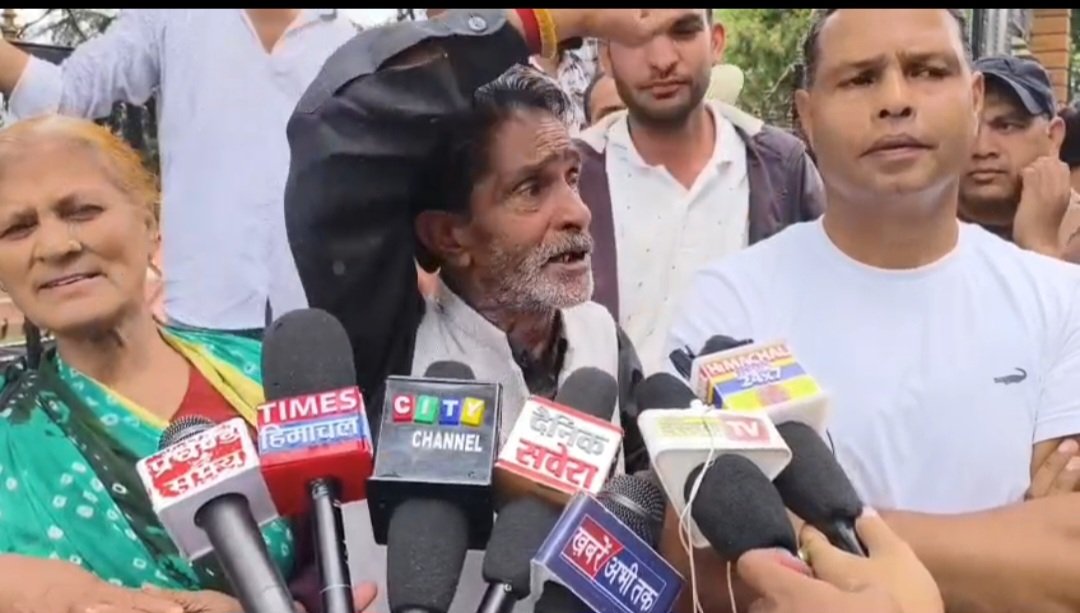
Street vendors of Shimla’s Lower Bazaar on Monday staged a protest against the Municipal Corporation’s decision declaring the area a ‘No-Vending Zone’, alleging that the move threatens the livelihood of hundreds of families while discriminating against vendors operating in nearby markets.
The protesters first gathered outside the Deputy Commissioner’s office before taking out a procession through Lower Bazaar, raising slogans and demanding that the decision be reconsidered.
Lower Bazaar, one of Shimla’s oldest and busiest commercial centres, has historically served as the city’s market for everyday essentials and remains a preferred shopping destination for the common public.
Speaking to the media, several vendors questioned why only Lower Bazaar had been declared a no-vending zone while vendors continue to operate in adjoining areas such as Ram Bazaar and Middle Bazaar.
“We fail to understand why only Lower Bazaar has been singled out,” one protester said. “Even when vendors are operating here, there is sufficient space for an ambulance or a fire tender to pass. Declaring the entire stretch a no-vending zone is unjustified.”
The protesters also claimed that the Municipal Corporation had earlier conducted a survey to identify authorised vending locations in Lower Bazaar. According to them, officials had proposed marking approved vending spots with blue lines and allowing vendors to operate from those designated spaces after completing the required formalities. However, they alleged that the proposal was never implemented.
Some protesters further alleged that divisions within the Lower Bazaar Vyapar Mandal had influenced the issue. They claimed that one faction of the traders’ body had approached the Himachal Pradesh High Court and was exerting pressure on the authorities, ultimately resulting in the declaration of Lower Bazaar as a no-vending zone. The allegation could not be independently verified.
The vendors also expressed concern over repeated eviction drives, stating that they are often asked to vacate their vending spots despite awaiting a permanent rehabilitation mechanism. Some alleged that obtaining copies of court orders, which they say are cited during enforcement drives, has been difficult, affecting their ability to pursue legal remedies.
When contacted, Municipal Commissioner Bhupinder Attri rejected allegations of arbitrary action and maintained that the Corporation was implementing the law as approved by the competent authority.
“We are acting strictly as per the Act, Rules, Scheme and Bye-laws,” Attri told Himachal Scape.
He further said that all decisions had been approved by the Town Vending Committee (TVC), duly constituted in accordance with law and comprising proper representation of street vendors.
Also read Committee initiates policy drafting for Street Vendors in Himachal Pradesh
The dispute centres on the implementation of the Street Vendors (Protection of Livelihood and Regulation of Street Vending) Act, 2014, which seeks to balance vendors’ right to livelihood with citizens’ right to unobstructed public spaces. The Act provides for surveys, constitution of Town Vending Committees, identification of vending and no-vending zones, and issuance of Certificates of Vending before regulating street vending.
Interestingly, during the Municipal Corporation’s recent anti-encroachment drive, when both street vendors and shopkeepers were prevented from occupying public space with stalls and merchandise, Lower Bazaar presented a markedly different picture. The market appeared significantly wider and less congested, with ample room for pedestrians and enough space in many stretches for a vehicle to pass comfortably—a contrast that has fuelled the continuing debate between ensuring free public access and protecting the livelihoods of street vendors.
So now, with both sides firmly defending their positions, the controversy over Lower Bazaar has once again brought into focus the challenge of balancing heritage market spaces, pedestrian convenience, public safety and the livelihoods of street vendors in Shimla’s congested commercial core.
About the Author

The HimachalScape Bureau comprises seasoned journalists from Himachal Pradesh with over 25 years of experience in leading media conglomerates such as The Times of India and United News of India. Known for their in-depth regional insights, the team brings credible, research-driven, and balanced reportage on Himachal’s socio-political and developmental landscape.