Geologist discovers rare palm fossil near Army Cantonment in Dharamshala
20 Million-Yr-old palm fossil Unearthed
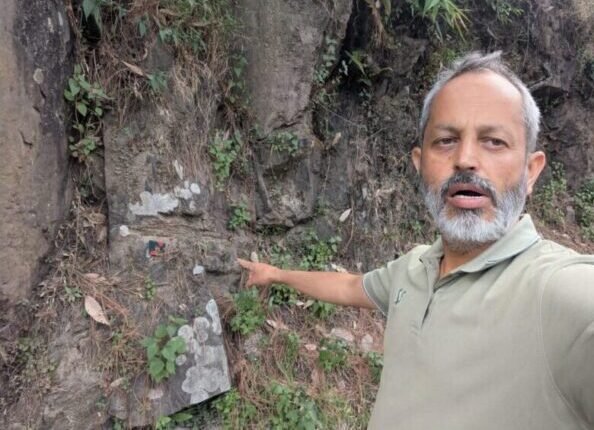
Geologist discovers rare palm fossil near Army Cantonment in Dharamshala
Dharamshala, June 5
In a major paleontological discovery coinciding with World Environment Day, renowned geologist and paleoclimate researcher Dr. Ritesh Arya has reported a rare fossil palm impression preserved in 20-million-year-old sandstone beds near the Army Cantonment area of Dharamsala, Himachal Pradesh.
The fossil, showing distinct parallel venation of a palm leaf, belongs to the Lower Miocene Dharamsala Formation and has been identified by Dr. Mahesh Prasad, Senior Scientist at the Birbal Sahni Institute of Palaeosciences (BSIP), Lucknow. Scientists consider the preservation of such delicate palm venation in sandstone to be rare and scientifically important.
Interestingly, the discovery was made while Dr. Arya was on a family visit to Dharamsala. His keen geological observations led him to notice unusual fossil impressions exposed within sandstone outcrops near the cantonment area.
Also Read 45-Million-Year-Old Snakehead Fish Fossil discovered in Himachal’s Subathu formation
According to Dr. Arya, the fossil provides strong evidence that the Himalayan region, presently known for its cool mountain climate, once supported tropical vegetation nearly 20 million years ago. He noted that such fossils preserve valuable records of ancient climates, ecosystems, and environmental changes that shaped the Himalayas over geological time.
The discovery also revives the historic paleobotanical legacy of pioneering geologist Henry Benedict Medlicott, who reported fossil plant remains from the Kasauli region during the nineteenth century, helping establish the tropical climatic history of the Himalayan foothills.
Calling for the protection of the newly discovered fossil locality, Dr. Arya has urged authorities to preserve the specimen in situ and develop the area as a Geoheritage and Geotourism Site for education, research, and sustainable tourism.
The finding gains added significance on World Environment Day, as it links ancient paleoenvironmental records with modern concerns about climate change, biodiversity, and environmental conservation.
Dr. Arya also highlighted that several rare fossil palm specimens discovered earlier from Kasauli and Ladakh are presently preserved in the Tethys Fossil Museum, Dangyari, Himachal Pradesh, where they serve as important evidence of the ancient tropical past of the Himalayas.
The discovery stands as a reminder that rocks and fossils are natural archives of Earth’s climate history and underline the importance of conserving geoheritage for future generations.
About the Author

The HimachalScape Bureau comprises seasoned journalists from Himachal Pradesh with over 25 years of experience in leading media conglomerates such as The Times of India and United News of India. Known for their in-depth regional insights, the team brings credible, research-driven, and balanced reportage on Himachal’s socio-political and developmental landscape.