Rainfall remained ‘normal’ despite an 11% deficit, but 652.3 mm puts 2026 among the state’s lower-rainfall monsoons of the past 125 years
Shimla, Oct 3
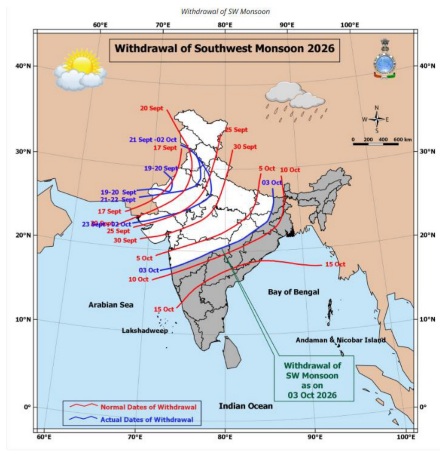
Himachal Pradesh’s 2026 monsoon has ended with an unusual combination of a late withdrawal and below-normal rainfall. The Southwest Monsoon withdrew from the entire state on October 3—eight days after its normal withdrawal date of September 25—while seasonal rainfall stood at 652.3 mm, 11% below the long-period normal of 734.4 mm.
According to the India Meteorological Department (IMD), Meteorological Centre, Shimla, the monsoon entered Himachal Pradesh on June 30 and covered the entire state by July 1. Its normal arrival date is June 25, making this year’s onset around five days late.
The more significant figure, however, lies in the longer historical record. The 652.3 mm rainfall recorded this year ranks as the 41st lowest monsoon rainfall in Himachal Pradesh in the 125-year period from 1901 to 2026. At the other end of the historical scale, the state recorded its highest monsoon rainfall of 1,314.6 mm in 1922.
A “normal” monsoon with 82 mm less rain
Despite receiving 82.1 mm less rainfall than normal, IMD has classified the state’s overall monsoon precipitation as normal. The seasonal total of 652.3 mm compares with the normal 734.4 mm, translating into an 11% negative departure.
The state-wide figure, however, masks considerable geographical variation.
Ten districts—Kinnaur, Una, Bilaspur, Kullu, Chamba, Kangra, Mandi, Shimla, Sirmaur and Solan—received normal precipitation during the season. Hamirpur recorded deficient rainfall, while Lahaul-Spiti experienced large deficient rainfall, according to the IMD.
A monsoon increasingly defined by timing
The IMD’s 2015–2026 record also shows how widely the dates of monsoon arrival and withdrawal have varied in Himachal.
The monsoon withdrew as late as October 11 in 2019 and October 10 in 2021. In contrast, it departed on September 26 last year. This year’s October 3 withdrawal therefore comes after a relatively early exit in 2025, but remains within the broad range seen over the past decade.
The onset dates have been equally variable. The monsoon arrived as early as June 13 in 2021, while its arrival was delayed until July 2 in 2019. In 2026, the onset on June 30 was again later than the normal June 25 date.
The bigger story is not simply more or less rain
The 2026 season therefore leaves behind a more nuanced picture than a simple “normal monsoon” label suggests. The state received less rain than its long-period average, the monsoon arrived late, and it also stayed later into autumn. At the same time, the statewide rainfall departure remained within the range that IMD classifies as normal.
For Himachal, where rainfall is distributed unevenly across sharply different terrain, the district-level variation may be as important as the state average. This year’s figures underline that distinction, particularly with Lahaul-Spiti recording large deficiency while most of the state remained in the normal category.
About the Author

Himachal ki har badi khabar, sabse pehle aapke paas
Breaking news, local updates aur exclusive stories — seedha WhatsApp ya Email par. Free. No spam.
WhatsApp Alerts
Instant news seedha aapke phone par. Ek click me subscribe karein.
Subscribe on WhatsAppEmail Newsletter
Har nayi post ka link aapke inbox me. Kabhi bhi unsubscribe karein.