Shimla, Nov 20
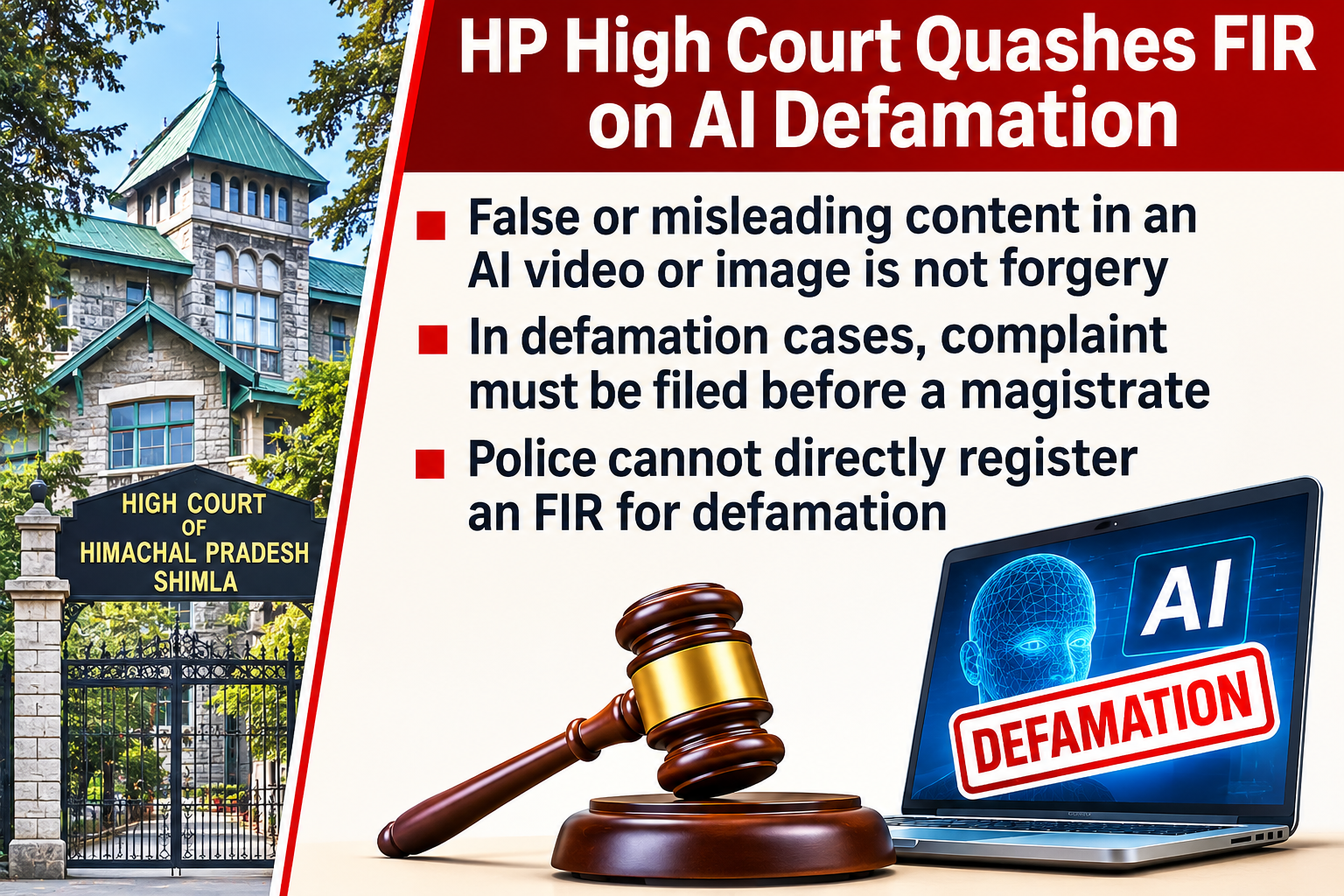
The Himachal Pradesh High Court has quashed an FIR registered over allegations of defamation through AI-generated videos and photographs circulated on Facebook, holding that false or misleading content in an electronic record does not, by itself, amount to forgery.
The court observed that where the allegations essentially constitute defamation, the aggrieved person must initiate proceedings by filing a private complaint before the competent magistrate. The police cannot directly register an FIR and investigate a purely defamatory offence in the absence of legally sustainable cognizable offences.
The case originated from an FIR registered at Ghumarwin police station in Bilaspur district on September 2, 2026. The complainant had alleged that he and his family members were being defamed through AI-generated videos and photographs circulated on Facebook.
The disputed video allegedly accused the complainant of extending benefits under the ‘Our Family, A Happy Family’ scheme to his relatives and friends in exchange for money and subsequently taking back the money.
Acting on the complaint, police registered a case under Sections 351(2), 356(2) and 336(4) of the Bharatiya Nyaya Sanhita (BNS). During the investigation, Section 353(1)(b) was also added.
Accused Suresh Kumar and another petitioner subsequently approached the High Court, challenging the legality of the FIR. They contended that the allegations essentially related to defamation and that the police could not initiate an investigation without following the procedure prescribed under the law. They also alleged that forgery and other provisions had been invoked to facilitate a police investigation in what was essentially a private dispute arising out of political rivalry.
Justice Rakesh Kainthala, while examining the matter, observed that forgery involves making a false document or electronic record by claiming it to have been created or authorised by another person. The FIR did not allege that the AI-generated video had been created in the name or authority of someone else. Merely carrying false or misleading information could not make an electronic record a forged document.
The court also examined the invocation of Section 353(1)(b) of the BNS and held that a video accusing an individual of corruption or nepotism did not, in itself, amount to creating public alarm or inciting an offence against the State.
Holding that the offences invoked by the police were not legally sustainable on the allegations contained in the FIR, the High Court quashed the criminal proceedings.
The ruling underscores the distinction between defamatory content and forgery, making it clear that the use of AI-generated material does not automatically attract criminal provisions relating to fabrication of electronic records.
About the Author

Himachal ki har badi khabar, sabse pehle aapke paas
Breaking news, local updates aur exclusive stories — seedha WhatsApp ya Email par. Free. No spam.
WhatsApp Alerts
Instant news seedha aapke phone par. Ek click me subscribe karein.
Subscribe on WhatsAppEmail Newsletter
Har nayi post ka link aapke inbox me. Kabhi bhi unsubscribe karein.