Shimla, Dec 11,
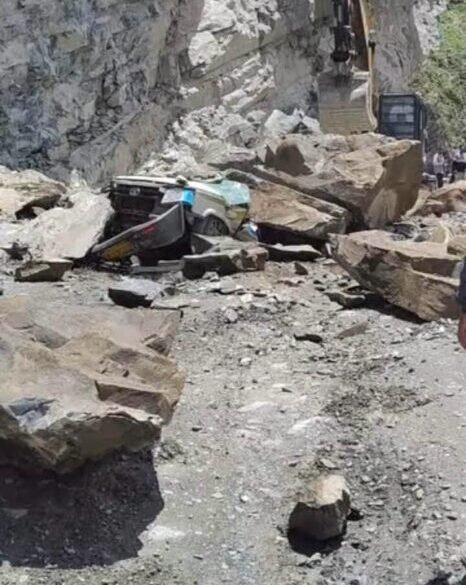
A landmark scientific reconstruction has revealed that the deadly 2021 Batseri rockfall in Kinnaur, a sensitive Himalayan district nearing the Indo–China border, was the culmination of long-term climatic stresses rather than a sudden freak event. By decoding nearly four centuries of climate history preserved in ancient Deodar trees of the Sangla valley, researchers have shown how prolonged drying trends and spring moisture deficits weakened the region’s slopes to the point where a single monsoon burst could trigger a catastrophic collapse. The rockfall killed nine tourists in July 2021, but the vulnerability of the terrain above Batseri was centuries in the making.
Scientists at the Birbal Sahni Institute of Palaeosciences (BSIP) reconstructed a 378-year hydroclimatic record for the Sangla valley and identified 53 rockfall events since 1853 using dendroclimatology and dendrogeomorphology techniques. Their findings, published in the journal Catena, show that the Deodars around Batseri—some between 378 and 463 years old—contain a detailed memory of the region’s changing climate, including a marked shift from wetter spring conditions during the Little Ice Age to increasingly drier springs after 1757 CE. This drying intensified sharply after 1960, matching global climate change patterns and directly influencing slope stability in this border-adjacent zone of Kinnaur.
The scars on trees injured during the 2021 rockfall helped scientists identify earlier, previously undocumented rockfalls stretching back more than 160 years. Of the 53 events detected, eight were major, and most aligned with years of severe spring drought. Moisture deficits during the crucial February–April period reduced vegetation cover and weakened soil cohesion on the fragile slopes overlooking Batseri. When an intense monsoon spell followed such dry phases, the slopes became primed for failure. In hindsight, conditions preceding the July 2021 tragedy replicated the same pattern recorded repeatedly in the Deodars: weakened slopes shaped by climatic stress, tipped over the edge by a burst of heavy rainfall.
Because the Sangla valley lies barely a kilometre from the Indo–China border, the study carries both ecological and strategic significance. The trees show how sensitive this terrain is to the behaviour of Western Disturbances, which deliver the winter precipitation essential for early-season vegetation growth. Even minor shifts in the intensity or timing of these disturbances can restructure the valley’s entire slope dynamics. The drying trend that began in the mid-eighteenth century and accelerated in recent decades created a long arc of vulnerability, making the Batseri slopes increasingly unstable despite their deceptively solid facade.
For families who lost loved ones, the study offers a sobering explanation: the 2021 disaster was not a sudden act of nature but the eventual result of climatic and geomorphic forces silently accumulating over generations. The monsoon outburst merely activated a slope already weakened by centuries of moisture imbalance. In this sense, the tragedy at Batseri becomes part of a larger Himalayan narrative in which long-term climate shifts dictate present-day hazard outcomes.
The BSIP research introduces a crucial scientific foundation for rethinking hazard preparedness in Kinnaur and other Himalayan regions near the Indo–China border. With climate change deepening and extreme weather events intensifying, the study argues for integrating long-term hydroclimatic evidence into planning for tourism, residential zones, border infrastructure, and road networks. The Deodars of Sangla valley—silent witnesses to centuries of droughts, snow cycles, and rockfalls—reaffirm that understanding the past is essential for safeguarding communities in an increasingly precarious mountain landscape.
About the Author

The HimachalScape Bureau comprises seasoned journalists from Himachal Pradesh with over 25 years of experience in leading media conglomerates such as The Times of India and United News of India. Known for their in-depth regional insights, the team brings credible, research-driven, and balanced reportage on Himachal’s socio-political and developmental landscape.