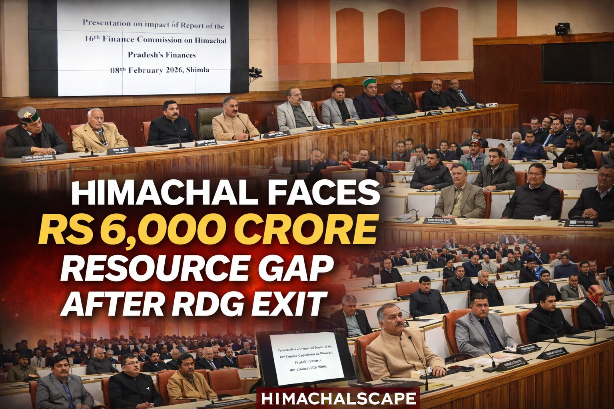
Photo used for indicative purpose only. Source: AI
Shimla, Feb 10,
Himachal Pradesh seems to be staring at a fiscal setback after the Sixteenth Finance Commission recommended that the state receive only 0.914 per cent of the Centre’s divisible tax pool under horizontal (inter-se) distribution. The allocation places the hill state among the lowest recipients in the country despite its strong governance indicators, high human development performance, ecological contribution and long history of fiscal discipline. This development can be noted amidst former senior bureaucrats who state that the new framework structurally disadvantages smaller hill states like Himachal Pradesh.
How the devolution formula works
Under the Sixteenth Finance Commission’s horizontal devolution formula, the highest weight of 42.5 per cent has been assigned to per capita GSDP distance, followed by 17.5 per cent to population based on the 2011 Census. Demographic performance, geographical area, forest cover and contribution to GDP carry equal weightage of 10 per cent each. While the formula appears balanced and data-driven on paper, its outcome seems to be providing a sharp concentration of resources in large and populous states.
Large states dominate the divisible pool
The inter-se distribution table shows Uttar Pradesh accounting for 17.619 per cent of the divisible pool, followed by Bihar at 9.948 per cent, Madhya Pradesh at 7.347 per cent, West Bengal at 7.215 per cent and Maharashtra at 6.441 per cent. Rajasthan has been allocated 5.926 per cent, Odisha 4.420 per cent, Andhra Pradesh 4.217 per cent, Karnataka 4.131 per cent and Tamil Nadu 4.097 per cent. In contrast, hill and smaller states remain clustered at the bottom, with Uttarakhand at 1.141 per cent, Arunachal Pradesh at 1.354 per cent, Himachal Pradesh at 0.914 per cent and Goa at 0.365 per cent. The pattern underscores how population-heavy states command a disproportionately larger share of central tax revenues.
‘ Apples among oranges’: Former officials question the framework
Former Director of Public Relations B.D. Sharma, former Deputy Commissioner, Kullu B.M. Nanta and former Commissioner of Shimla Municipal Corporation H.N. Kashyap have criticised the framework, arguing that while it appears neutral, it effectively penalises states with lower population growth, higher per capita income and significant ecological responsibility. According to them, the Commission failed to recognise the structural disabilities of hill states and prepared its report by “putting apples among oranges.” They contend that better-performing states should be rewarded rather than fiscally constrained.
Revenue deficit grant: From lifeline to zero
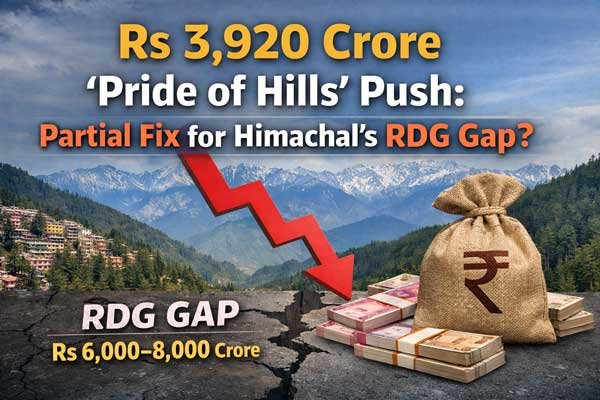
The situation is compounded by the complete withdrawal of Revenue Deficit Grants (RDG) under the Sixteenth Finance Commission. Since attaining full statehood in 1971–72, Himachal Pradesh has continuously received RDG to offset revenue gaps arising from difficult terrain, scattered habitation and limited taxable capacity. RDG stood at Rs 101 crore under the Sixth Finance Commission, increased to Rs 207 crore under the Seventh and Rs 223 crore under the Eighth, before rising to Rs 523 crore during the Ninth Commission period and Rs 772 crore under the Tenth. It climbed to Rs 1,979 crore under the Eleventh Commission, crossed Rs 10,000 crore during the Twelfth, dipped during the Thirteenth, and again rose to Rs 7,889 crore under the Fourteenth and Rs 17,198 crore during the Fifteenth Finance Commission period up to 2025–26. Under the Sixteenth Finance Commission, RDG has been reduced to zero.
Why RDG withdrawal hurts Himachal more
Data in the “RDG as a Lifeline” document shows that during the Fifteenth Finance Commission award period, Himachal Pradesh received an average annual RDG of about Rs 7,440 crore against a 2025–26 budget size of roughly Rs 58,514 crore, meaning RDG constituted about 12.71 per cent of its total budget. Only a few special category states showed higher dependence, with Nagaland at 17.21 per cent and Tripura at 12.27 per cent. Mizoram’s RDG share stood at 8.70 per cent, Manipur at 6.53 per cent and Uttarakhand at 5.56 per cent. In contrast, for larger and economically stronger states, RDG formed only a marginal part of their budgets. Kerala’s RDG constituted about 2.41 per cent, Punjab 2.20 per cent, West Bengal 2.06 per cent and Andhra Pradesh 1.89 per cent. The ratio fell sharply for Rajasthan at 0.55 per cent, Tamil Nadu at 0.09 per cent, Karnataka at 0.08 per cent and Haryana at a negligible 0.01 per cent. Former officials argue that while RDG withdrawal is fiscally neutral for such states, it removes a critical compensatory support mechanism for Himachal Pradesh.
Risk of higher borrowing and development compression
According to former officers, the abrupt withdrawal of RDG could force hill states either to compress development expenditure or increase borrowing. They maintain that RDG should have been tapered gradually by one to two percentage points across successive award periods, with performance-linked incentives for better tax collection, low population pressure and ecological services. Instead, the sudden cut creates a fiscal shock for a state already managing structural constraints.
The structural cost of being a hill state
Himachal Pradesh also bears 25 per cent of the cost of railway projects despite such projects being of national importance, while carrying the environmental and social costs associated with hydropower, dams, irrigation systems and forest conservation. High infrastructure costs due to difficult terrain and dispersed habitation further increase expenditure burdens. Former officials argue that such structural realities demand a federal framework that rewards sustainable development and ecological responsibility.
A larger federal debate emerges
The issue revives a broader debate within India’s cooperative federal structure — whether fiscal transfers should primarily reward population size and income distance, or compensate structural disadvantages and ecological contribution. According to former administrators, states that have demonstrated stronger governance, fiscal discipline and sustainable development must be supported rather than constrained. With RDG discontinued and the tax share limited to 0.914 per cent, Himachal Pradesh now faces one of its most challenging fiscal phases since statehood, making the coming years crucial for balancing development needs with fiscal prudence.
About the Author

The HimachalScape Bureau comprises seasoned journalists from Himachal Pradesh with over 25 years of experience in leading media conglomerates such as The Times of India and United News of India. Known for their in-depth regional insights, the team brings credible, research-driven, and balanced reportage on Himachal’s socio-political and developmental landscape.