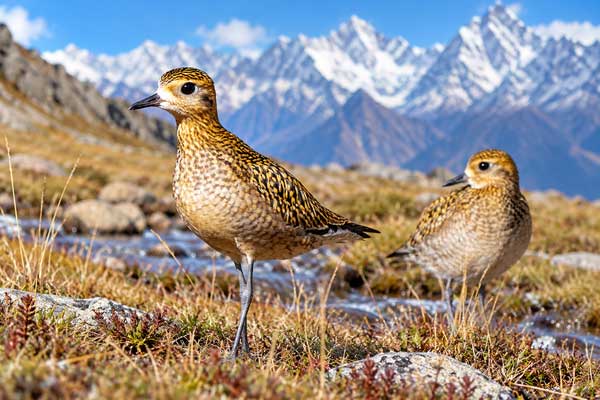
Rare pacific golden plover recorded for first time in Kinnaur
Shimla, Oct 23,
The discovery of a Pacific Golden Plover in the high-altitude landscape of Kinnaur has opened a new window into the study of bird migration in the Himalayas, highlighting how systematic field observations continue to reveal unexpected dimensions of wildlife distribution in mountain ecosystems.
An immature Pacific Golden Plover (Pluvialis fulva) was recorded near a stream in an alpine meadow in the Kalpa area of Kinnaur district on October 5, at an altitude of approximately 3,800 metres above sea level. According to the observers, this is the first documented record of the species in Kinnaur.
The sighting raises interesting questions about the movement of migratory birds across the Himalayan landscape, where altitude, weather, food availability and the distribution of suitable resting habitats can influence migration routes. Although seasonal migration is an established biological phenomenon, individual sightings in unexpected locations continue to expand scientific knowledge of how birds use mountain environments during their long-distance journeys.
The bird was spotted by Kinnaur-based naturalist Mahesh Negi Ronseru and Himanshu Chaudhary during a birdwatching expedition, along with three enthusiasts visiting from Pune — Chandrakant Bhagwat, Sudhakar Kulkarni and Shriram Takle.
The observers identified the bird through distinguishing physical characteristics, including its relatively long legs, elongated tertiary flight feathers reaching the tip of the tail, and comparatively limited white colouring on the underparts. The patterns on its scapular feathers also helped distinguish it from the similar-looking European Golden Plover (*Pluvialis apricaria*).
The record adds to the growing body of information about the species in Himachal Pradesh. Earlier observations include a record from the Pong Dam area documented by Dr Abhinav Chaudhary in May 2026, besides records from the Trans-Himalayan region of Lahaul-Spiti.
Also read: Migratory Birds turn Kinnaur’s Kuppa Dam into a Winter haven
The October sighting in Kinnaur coincides with the southward migration period. However, the presence of the bird in an alpine meadow at such a high elevation makes the observation particularly interesting. Small streams, marshy patches and other water sources may provide temporary feeding and resting opportunities for migratory birds moving through otherwise difficult mountain terrain.
Bird migration is an evolutionary adaptation shaped over generations by changing seasons, food availability, breeding requirements and survival pressures. Yet migration is not always a rigid journey along an unchanging route. Birds may use different stopover locations, and weather conditions, ecological changes and the availability of suitable habitats can influence their movements. An isolated sighting cannot, by itself, establish a change in a species’ migration route, but repeated observations can help researchers identify emerging patterns and formulate new questions for investigation.
The Kinnaur record therefore offers an opportunity for further field studies to establish whether the area is occasionally used by the species during migration or represents a more regular, previously undocumented stopover.
Mahesh Negi Ronseru, who has been documenting wildlife in and around Kalpa, said several parts of Kinnaur remained insufficiently explored from a scientific perspective. Systematic surveys, he said, could lead to further discoveries and improve understanding of the district’s biodiversity.
Local naturalists can play an important role in this process by recording sightings with photographs, dates, locations and altitude details, enabling researchers to verify observations and build reliable databases of species distribution.
The discovery also underlines the ecological importance of high-altitude wetlands, streams and alpine meadows, whose value extends beyond the wildlife immediately visible to visitors. Protecting these habitats and documenting their seasonal use by birds could contribute to a better understanding of the ecological connections linking the Himalayas with distant regions along migratory routes.
As the study of bird migration advances, such discoveries serve as reminders that even familiar biological processes continue to offer new questions. In the remote mountains of Kinnaur, a single birdwatching observation has added a new geographical record and opened fresh avenues for exploring the relationship between evolution, migration and the fragile ecology of the Himalayas.
About the Author

Himachal ki har badi khabar, sabse pehle aapke paas
Breaking news, local updates aur exclusive stories — seedha WhatsApp ya Email par. Free. No spam.
WhatsApp Alerts
Instant news seedha aapke phone par. Ek click me subscribe karein.
Subscribe on WhatsAppEmail Newsletter
Har nayi post ka link aapke inbox me. Kabhi bhi unsubscribe karein.