Himachal Poverty data reveals uneven rural progress
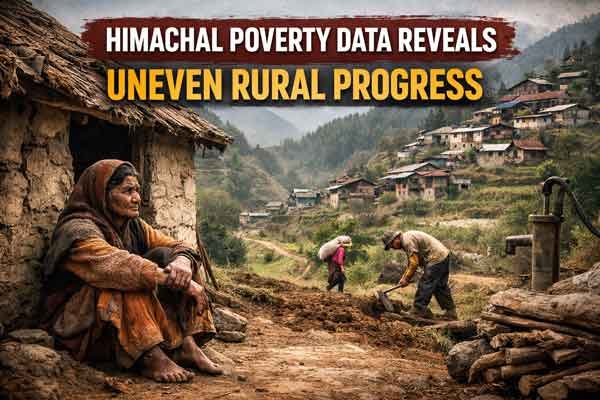
Himachal Poverty data reveals uneven rural progress
Shimla, March 26,
Himachal Pradesh’s latest poverty data has revealed an uneven pattern of rural progress, where nearly half of Below Poverty Line (BPL) families show signs of improvement, but a large segment continues to remain economically vulnerable and dependent on low-income livelihoods.
A sample-based assessment by the Department of Economic and Statistics reveals that 49.9 percent of BPL households have improved their standard of living, even as structural vulnerabilities persist across income, housing and access to services. The state currently has 2,65,205 BPL families as of February 2022, underlining the scale of the challenge.
The data points to a fragile transition rather than a decisive shift out of poverty. While more than half of surveyed households reported monthly incomes above Rs 2,500, a closer look suggests that this remains a low threshold, offering limited economic security. The dependence on informal and seasonal work remains pronounced, with a majority of households engaged as casual labourers under schemes like MGNREGA or in other low-paying jobs. Subsistence farming continues to be the second-largest source of livelihood, reinforcing the lack of diversification in rural incomes.
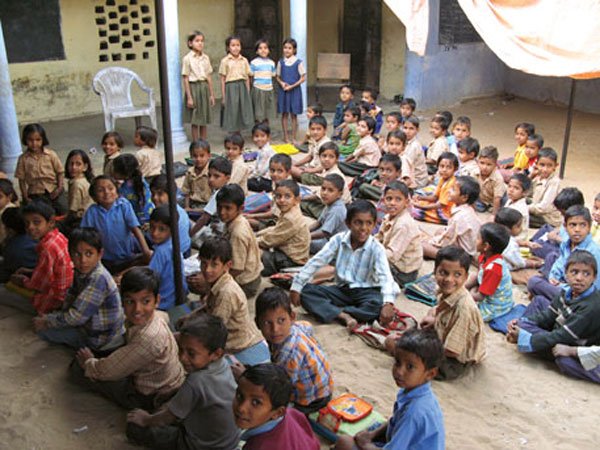
Education levels present a mixed picture. Although school attendance among children aged 5 to 14 is nearly universal, over one-fifth of the surveyed population remains illiterate, indicating that gains in enrolment have not yet fully translated into long-term educational outcomes. This gap could have implications for future employability and income mobility.
Housing conditions further reflect the incomplete nature of progress. A significant proportion of families continue to live in semi-pucca or kutcha houses, with only a minority having access to fully pucca structures. While land ownership is widespread—over 90 percent of households own land—the productivity and economic return from these holdings appear limited, given the continued reliance on wage labour.
Access to basic amenities shows uneven improvement, particularly in hill regions. While drinking water is available within premises for a majority of households in the plains, families in higher-altitude areas still face the burden of fetching water from a distance. At the same time, sanitation coverage has improved considerably, with most households now having access to latrine facilities and no reported cases of open defecation, suggesting that targeted interventions in this sector have yielded results.
Also read:HP Cabinet approves changes in Labour/Factories act, also propose to enhance the upper income ceiling limit for BPL selection
Food security indicators suggest relative stability, with most households reporting sufficient food availability through the year. However, a notable proportion still experiences periodic shortages, pointing to underlying income volatility. The survey also highlights low levels of indebtedness, with a majority of families free from loans, though this may also reflect limited access to formal credit rather than financial resilience.
What stands out is the limited mobility of these households. Migration remains negligible, with most families continuing to depend on local opportunities. This could indicate strong community anchoring, but also a lack of viable employment avenues beyond the immediate region.
The survey’s internal scoring categorises nearly equal proportions of households as “poor” and “not so poor,” underscoring a large segment that sits on the edge of economic vulnerability. This group, while showing signs of improvement, remains highly sensitive to disruptions such as job loss, crop failure or health emergencies.
The demand patterns emerging from the survey reinforce this reality. Housing support, wage employment and avenues for self-employment remain the top priorities among BPL families, reflecting both immediate needs and aspirations for stability.
The findings suggest that while welfare programmes have delivered measurable gains, the next phase of policy intervention may need to focus on income diversification, quality of employment and region-specific infrastructure gaps. Without such shifts, a significant section of Himachal’s BPL population could remain trapped in a cycle of marginal improvement without achieving sustained economic security.
About the Author

The HimachalScape Bureau comprises seasoned journalists from Himachal Pradesh with over 25 years of experience in leading media conglomerates such as The Times of India and United News of India. Known for their in-depth regional insights, the team brings credible, research-driven, and balanced reportage on Himachal’s socio-political and developmental landscape.